
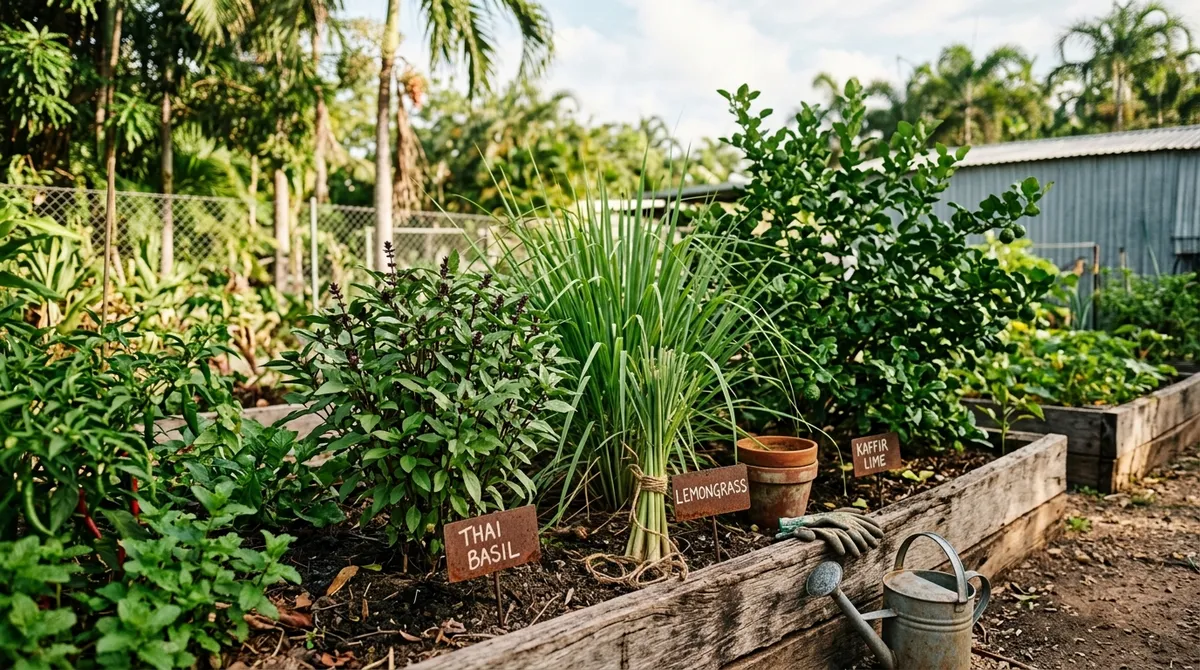
Growing Herbs in Darwin
Lemongrass, turmeric, galangal, Thai basil, Vietnamese mint, and managing monsoon rains and dry season heat in the Top End
Herb gardening in Darwin requires a complete rethink if you are coming from a southern Australian mindset. Rosemary, sage, and thyme do not survive the wet season. Coriander bolts in a week during the build-up. Parsley burns in the dry season sun. The herbs that flourish in Darwin are tropical and Southeast Asian species that actually want heat, humidity, and drenching rain. Build your herb garden around these species and you will have fresh herbs year-round.
Darwin's dry season (May to September) also opens a brief window for a few temperate herbs, but the focus should always be on tropical varieties that produce reliably in every season.
🌱 Plants in this guide: Lemongrass, Turmeric, Galangal, Vietnamese Mint, Thai Basil, Basil, Coriander, Parsley and 2 more, all listed under Plant profiles at the end of this guide. Each plant profile has sowing times for your region, companion plants and common pests.
Year-Round Tropical Herbs
Lemongrass (Cymbopogon citratus)
Lemongrass is the most reliable herb in Darwin. Plant a single stalk and it produces a massive clump within months. Every garden in Palmerston and Darwin's northern suburbs should have at least one clump. It handles full sun, monsoon rain, sandy soil, dry season neglect, and cyclone-force winds (it just flattens and bounces back). Harvest by twisting individual stalks from the base. The white inner core is the part used in cooking.
Plant lemongrass along fence lines or as a backdrop to smaller herbs. It grows 1-1.5 metres tall and forms a dense screen. Divide clumps every 2-3 years to keep them productive. Share divisions freely; lemongrass is the easiest plant in Darwin to give away because everyone wants it.
Turmeric (Curcuma longa)
Turmeric is a wet season crop that grows effortlessly in Darwin. Plant rhizomes in October or November, just as the first storms arrive. The plants grow 60-90 centimetres tall through the wet season, producing broad green leaves. As the dry season begins in May, the foliage yellows and dies back. Dig the rhizomes at this point. Each original piece produces 2-3 kilograms of fresh turmeric, enough for months of cooking.
Plant in a position with morning sun and afternoon shade. Humpty Doo and Berry Springs gardeners with large blocks can dedicate entire rows to turmeric. Suburban Darwin and Palmerston gardeners grow it well in large pots (40 centimetre diameter minimum). The soil should be rich and well-drained; mix compost into Darwin's sandy soils before planting.
Galangal (Alpinia galanga)
Galangal is a larger, more vigorous relative of ginger that reaches 1.5-2 metres in Darwin's conditions. The thick, pale rhizomes have a sharp, aromatic flavour essential in Thai cooking. Galangal is a perennial in Darwin, growing year-round without dying back, though growth slows in the dry season.
Plant rhizome divisions in a sheltered spot with morning sun. Galangal handles the wet season without drama. Harvest rhizomes from the outer edges of the clump after 12 months. A single established plant provides more galangal than most households can use. The plant also produces attractive white flowers that add ornamental value.
Vietnamese Mint (Persicaria odorata)
Vietnamese mint thrives in Darwin's wet, shady conditions. The pointed leaves have a flavour that blends coriander and mint, making it an excellent coriander substitute during the months when true coriander refuses to grow. Vietnamese mint spreads vigorously by runners, so plant it in a pot or a contained bed with solid borders.
Grow Vietnamese mint in the shadiest, wettest part of the garden. Under a tap, beside an air conditioner drain, or in a pot that sits in a saucer of water are all ideal spots. It handles full shade and constant moisture. Cut stems back to 10 centimetres regularly to encourage fresh, tender growth. Cuttings placed in a glass of water root within a week.
Thai Basil and Perennial Basil
Thai basil handles Darwin's humidity and heat far better than Italian sweet basil. The sturdy leaves resist downy mildew, and the anise flavour intensifies in warm conditions. Plants grow year-round in Darwin, though production peaks during the dry season. Pinch flowers regularly to extend the harvest period.
Perennial basil (sometimes sold as African basil) is the most reliable basil for Darwin. It grows as a small woody shrub reaching 60-80 centimetres and produces continuously for 2-3 years. The flavour is milder than sweet basil but works well in salads, stir-fries, and as a garnish. Perennial basil handles the wet season without collapsing, which makes it the go-to basil for Top End gardens.
Dry Season Herbs: A Short Window
The dry season from May to August provides a brief window for a few temperate herbs. Darwin's dry season temperatures (daytime 30-33 degrees, overnight 19-22 degrees) are warmer than ideal for these species, but they produce for a limited period.
- Coriander: Sow seeds directly every 2-3 weeks from May to July. Use slow-bolt varieties. Expect 3-4 weeks of useful leaf harvest before bolting. Harvest the seeds for use as a spice once flowers form. By August, rising temperatures make coriander unviable.
- Parsley: Plant seedlings in May. Flat-leaf Italian parsley lasts longer than curly types. Provide afternoon shade. Production declines sharply by August. In Humpty Doo and rural areas, slightly cooler overnight temperatures extend the season a week or two.
- Dill: Sow direct in May or June. Quick to bolt, so harvest frequently. The flowers attract beneficial insects to the garden. Treat dill as a short-term crop rather than a permanent fixture.
- Chives: Grow in pots in a shaded position. Chives survive year-round in Darwin if protected from full sun and kept moist, but they never thrive the way they do in cooler climates.
Managing Heat and Monsoon
Darwin's two main challenges for herbs are the dry season heat (consistently above 30 degrees, peaking at 35 degrees from September to November) and the wet season deluge (1700mm of rain, mostly from December to March).
Strategies for both seasons:
- Shade is essential. Position herbs where they receive morning sun and afternoon shade. East-facing verandas in Darwin and Palmerston are perfect. A shade sail over a herb bed provides the same protection in open gardens.
- Drainage is critical during the wet. Raised beds (at least 20 centimetres high) prevent waterlogging. In pots, ensure large drainage holes and elevate on pot feet. Remove saucers during the monsoon months.
- Mulch reduces soil temperature. Apply 5-8 centimetres of sugar cane mulch around herbs. Mulch keeps roots cooler during the dry season and prevents soil splash (which spreads fungal spores) during the wet.
- Water wisely during the dry. Darwin's dry season humidity is low (30-50%), so container herbs need daily watering. Drip irrigation on a timer is the most reliable method. Water in the early morning.
Soil and Feeding
Darwin's sandy soils drain freely but hold very little moisture or nutrients. Herbs growing in ground need regular additions of compost and aged manure. Work a 5-centimetre layer of compost into the top 15 centimetres of soil before planting. Top-dress with compost every 8 weeks.
For container herbs, use a premium potting mix with added perlite and compost. Standard potting mix compacts within 3-4 months in Darwin's heat. Refresh or replace the mix every 6 months.
Feed herbs with liquid organic fertiliser every 2 weeks during active growth. Seaweed-based feeds support root health and stress tolerance. Avoid high-nitrogen fertilisers, which produce lush growth that is more susceptible to fungal problems during the wet season.
Frequently Asked Questions
What herbs grow best in Darwin?
Tropical herbs thrive in Darwin. Lemongrass, turmeric, galangal, Vietnamese mint, Thai basil, and perennial basil all handle the heat and monsoon rains. Mediterranean herbs fail in Darwin's wet season. Coriander and parsley can grow during the dry season (May to August) but bolt quickly once temperatures exceed 33 degrees.
Can I grow coriander in Darwin?
Coriander grows during the dry season only, from May to July. Sow seeds directly every 2-3 weeks for continuous supply. Choose slow-bolt varieties. Even the best varieties bolt within 3-4 weeks once daytime temperatures climb above 33 degrees. Vietnamese mint is a better year-round alternative.
How do I keep herbs alive during Darwin's wet season?
Grow tropical herbs that thrive in monsoon conditions: lemongrass, turmeric, galangal, Vietnamese mint, and perennial basil. For vulnerable herbs, use pots with excellent drainage that can be moved under cover during heavy downpours.
When should I plant turmeric in Darwin?
Plant turmeric rhizomes in October or November, just before the wet season starts. Harvest the rhizomes in May or June after the foliage dies back. Each rhizome multiplies substantially, producing 2-3 kilograms of fresh turmeric per plant.
Plant profiles
Each profile has sowing times for your region, companion plants and common pests.
Free Monthly Planting Calendar
Get a personalised email each month with what to plant, seasonal tips, and harvest reminders for your region.
We send one email per month. Unsubscribe any time.