
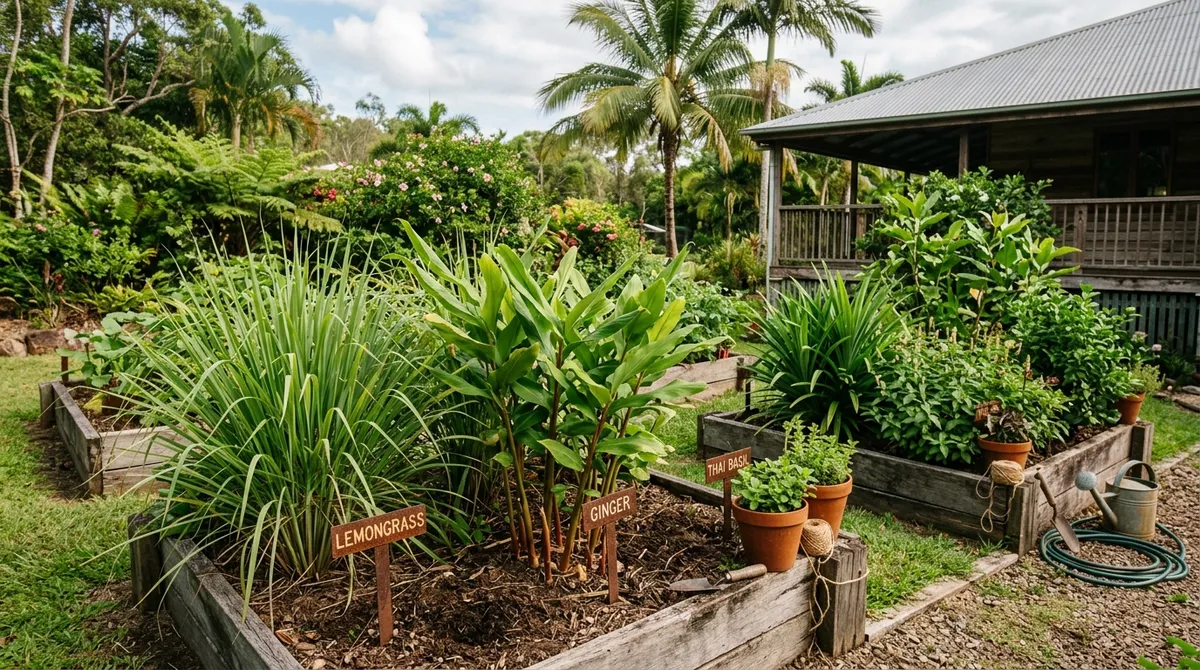
Growing Herbs in North Queensland
Tropical basil, lemongrass, turmeric, galangal, Vietnamese mint, and managing humidity in Townsville, Cairns, and the Tablelands
Standard herb gardening advice written for Melbourne or Sydney falls apart in North Queensland. Rosemary rots in the wet season. Coriander bolts within days. Parsley barely lasts a month. The herbs that thrive here are tropical and Southeast Asian species that actually prefer heat, humidity, and monsoonal rain. Once you shift your herb garden towards these plants, growing herbs in North Queensland becomes straightforward.
The dry season (April to October) also opens a window for some temperate herbs, particularly on the Atherton Tablelands where cooler nights extend their productive life.
🌱 Plants in this guide: Lemongrass, Turmeric, Galangal, Vietnamese Mint, Thai Basil, Basil, Coriander, Parsley and 2 more, all listed under Plant profiles at the end of this guide. Each plant profile has sowing times for your region, companion plants and common pests.
Best Tropical Herbs for North Queensland
Lemongrass (Cymbopogon citratus)
Lemongrass is the easiest herb to grow in North Queensland. It thrives in every part of the region, from Townsville to Cairns to the Tablelands. Plant a single division and it will form a dense clump within 6 months. Each clump produces dozens of usable stalks. Harvest by twisting and pulling individual stalks from the base. Lemongrass handles full sun, heavy rain, poor soil, and drought. It grows year-round and rarely suffers from pests or diseases.
Plant lemongrass as a border or backdrop to the herb garden. The dense foliage provides a windbreak for smaller herbs. Divide clumps every 2-3 years to keep them vigorous and share with neighbours.
Turmeric (Curcuma longa)
Turmeric grows like a weed in North Queensland's wet season. Plant rhizomes in October or November, just as the rains begin. The plants grow 60-90 centimetres tall with broad, lush leaves through the wet season. As conditions dry out in April and May, the foliage yellows and dies back. Dig the rhizomes at this point. Each original rhizome produces 2-3 kilograms of fresh turmeric.
Turmeric prefers rich, moist soil in a position with morning sun and afternoon shade. In Cairns and Innisfail, it grows in full shade. In Townsville, afternoon shade prevents leaf scorch. The Atherton Tablelands produce excellent turmeric; several commercial farms operate near Malanda and Millaa Millaa.
Galangal (Alpinia galanga)
Galangal grows similarly to turmeric but is a larger, more vigorous plant reaching 1.5-2 metres tall. It produces thick, pale rhizomes with a sharp, aromatic flavour essential to Thai and Southeast Asian cooking. Galangal is a perennial in North Queensland and does not die back in the dry season, though growth slows considerably.
Plant rhizome divisions in a sheltered spot with morning sun. Galangal prefers rich, well-drained soil with consistent moisture. Harvest rhizomes from the outer edges of the clump after 12 months. The plant regenerates from the centre, so harvesting from the edges keeps production continuous.
Vietnamese Mint (Persicaria odorata)
Vietnamese mint is a spreading groundcover herb with pointed leaves that taste of coriander and mint combined. It thrives in moist, shady conditions, making it ideal for the wet season when most other herbs struggle. Vietnamese mint grows aggressively in Cairns and Townsville; contain it in pots or a dedicated bed with borders.
This herb handles full shade and wet feet, two conditions that kill most other herbs. Plant it in the shadiest, wettest part of the garden. Harvest regularly by cutting stems back to 10 centimetres. It roots from every node, so cuttings placed in water or moist soil strike within a week.
Thai Basil and Perennial Basil
Thai basil (Ocimum basilicum var. thyrsiflora) handles North Queensland's humidity far better than Italian sweet basil. The leaves are smaller and sturdier, with an anise flavour that intensifies in warm conditions. Plants grow year-round and resist downy mildew better than Genovese types.
Perennial basil (Ocimum x africanum, sometimes sold as African basil) is the most reliable basil for the tropics. It grows as a small woody shrub, reaching 60-80 centimetres, and produces continuously for 2-3 years before needing replacement. The flavour is milder than sweet basil but useful in salads, stir-fries, and pesto. Perennial basil tolerates the wet season without collapsing.
Dry Season Herbs: The Temperate Window
The dry season from April to October allows a short window for temperate herbs, especially on the Atherton Tablelands where overnight temperatures drop to 10-14 degrees in June and July.
- Coriander: Sow seeds directly every 3-4 weeks from April to July. Choose slow-bolt varieties. In Townsville, coriander bolts within 3-4 weeks once daytime temperatures exceed 30 degrees. On the Tablelands, it holds for 6-8 weeks.
- Parsley: Plant seedlings in April. Flat-leaf Italian parsley lasts longer than curly types. Provide afternoon shade in Townsville and Cairns. On the Tablelands, parsley grows well from April through September.
- Rosemary: Grows as a perennial on the Atherton Tablelands if planted in very well-drained soil. In Townsville and Cairns, grow rosemary in pots with sandy mix and move under cover during the wet season.
- Dill: Sow direct from April to June. Quick to bolt in warm conditions, so harvest frequently. Best results on the Tablelands.
Managing Humidity and Wet Season Challenges
The wet season (December to March) is the hardest period for herb gardens in North Queensland. Humidity regularly exceeds 80%, rainfall totals reach 1000-2000mm in the Cairns region, and fungal diseases thrive.
Strategies for keeping herbs productive through the wet season:
- Grow tropical species: Stick with lemongrass, turmeric, galangal, Vietnamese mint, and perennial basil during the wet. These species actually perform their best in monsoon conditions.
- Raise your beds: Build herb beds at least 20 centimetres above ground level. In heavy clay areas around Townsville, go higher (30 centimetres). Good drainage prevents root rot.
- Improve airflow: Space herbs generously. Crowded plants trap moisture and promote fungal disease. Prune regularly to keep growth open.
- Use pots: Grow vulnerable herbs in pots that can be moved under a veranda or carport during heavy rain events. Terracotta pots breathe better than plastic in the tropics.
- Mulch carefully: Use a thin layer (3-5 centimetres) of coarse mulch during the wet season. Thick mulch holds too much moisture around stems and encourages rot.
Planting and Soil Tips
Most tropical herbs prefer rich, well-drained soil with plenty of organic matter. Mix compost and aged manure into beds before planting. In the Cairns region, the naturally rich volcanic-derived soils of the Tablelands grow herbs superbly with minimal amendment. Coastal Cairns soils tend to be sandy and benefit from extra compost. Townsville's heavy clay needs gypsum, coarse sand, and organic matter to open up the structure.
Feed herbs with liquid organic fertiliser every 2-3 weeks during the growing season. Seaweed-based feeds promote strong root growth. Avoid high-nitrogen fertilisers on basil and other leafy herbs, as they produce lush growth that is more susceptible to fungal attack.
Water herbs in the early morning so foliage dries before the heat of the day. Drip irrigation keeps water off the leaves and reduces fungal problems. During the dry season, most herbs need watering every 2-3 days in Townsville and every 3-4 days in Cairns.
Frequently Asked Questions
What herbs grow best in North Queensland?
Tropical herbs thrive in North Queensland. Lemongrass, turmeric, galangal, Vietnamese mint, Thai basil, and perennial basil all handle the heat and humidity. Mediterranean herbs like rosemary, thyme, and oregano struggle in the wet season but can grow in pots with excellent drainage during the dry season, particularly on the Atherton Tablelands.
Can I grow basil year-round in North Queensland?
Perennial basil and Thai basil grow year-round in North Queensland. Sweet basil (Genovese type) performs best during the dry season from April to October. Wet season humidity causes downy mildew and fungal problems on sweet basil, so switch to perennial basil during the monsoon months.
How do I stop herbs rotting in the wet season?
Raised beds or pots with excellent drainage are essential. Use a coarse, free-draining potting mix with extra perlite. Position herbs where they get morning sun but are sheltered from heavy afternoon downpours. Avoid overhead watering. Remove any dead or yellowing leaves promptly to reduce fungal spread.
When should I plant turmeric in North Queensland?
Plant turmeric rhizomes at the start of the wet season in October or November. The plant needs warmth and moisture to grow actively through the wet season. Harvest after the leaves die back in the following dry season, around May to July. Each rhizome multiplies significantly, producing 2-3 kilograms of fresh turmeric per plant.
Plant profiles
Each profile has sowing times for your region, companion plants and common pests.
Free Monthly Planting Calendar
Get a personalised email each month with what to plant, seasonal tips, and harvest reminders for your region.
We send one email per month. Unsubscribe any time.