
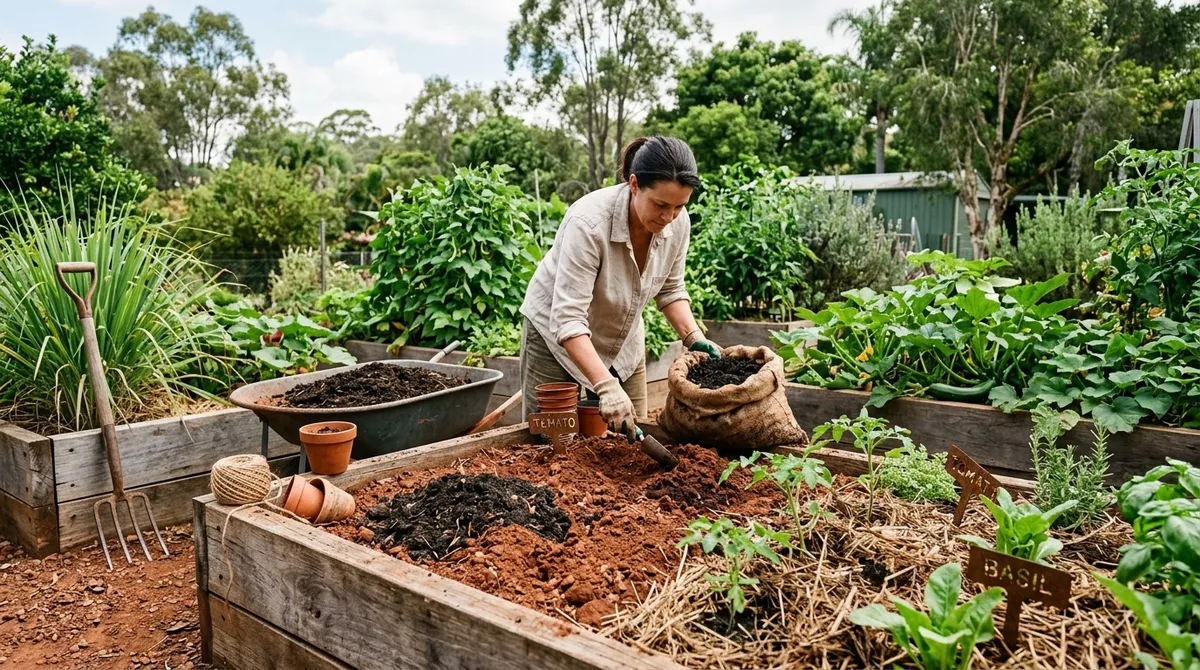
Improving North Queensland Soils
Red volcanic soil, sandy coastal soil, organic matter in tropical heat, and practical strategies for Townsville, Cairns, and the Atherton Tablelands
Soil in North Queensland varies dramatically over short distances. Drive an hour from Townsville's heavy coastal clay to the Atherton Tablelands and you are working with deep red volcanic earth. Head north to Cairns and the coastal fringe has sandy alluvial soils completely different to both. Each soil type has specific strengths and weaknesses for vegetable growing, and each needs a different improvement approach.
The common challenge across all North Queensland soils is the speed at which organic matter disappears. Tropical heat and moisture drive microbial activity at 3-5 times the rate of temperate climates. Compost you add in April is largely gone by August. This means soil improvement in the tropics is an ongoing process, requiring regular additions rather than a one-off fix.
Soil Types Across North Queensland
Townsville and Coastal Dry Tropics: Heavy Clay
The coastal strip from Townsville south to Bowen is dominated by heavy grey-brown clay soils derived from granite. These soils are dense, poorly drained, and crack deeply during the dry season. They hold nutrients well but waterlog easily during the wet season, creating anaerobic conditions that kill plant roots.
Improvement strategy for Townsville clay:
- Apply gypsum at 1-2 kilograms per square metre annually. Gypsum breaks up clay structure without altering pH. Spread it on the surface and water in. Results are gradual; expect visible improvement over 2-3 seasons.
- Add coarse organic matter: aged wood chips, sugar cane mulch, and rough compost. Fine compost disappears too quickly. Coarser material holds structure longer and creates channels for water and air.
- Build raised beds at least 20 centimetres high. Fill with a 50/50 mix of existing clay soil and compost. The raised profile ensures drainage during the wet season.
- Grow cover crops (lablab, cowpea, mung bean) during the wet season. Their roots break up compaction and add nitrogen. Chop and drop the plants before they seed to add organic matter.
Atherton Tablelands: Red Volcanic Soil
The Tablelands between Mareeba and Ravenshoe sit on deep basalt-derived red soils (krasnozems). These are among Australia's most fertile soils. They are naturally well-drained, hold moisture well, and have good structure. The red colour comes from high iron content.
The main limitation is acidity. Krasnozems typically have a pH of 4.5-5.5, which is too acidic for most vegetables (optimal range is 6.0-6.5). Apply agricultural lime at 200-500 grams per square metre annually, based on soil test results. Dolomite lime adds both calcium and magnesium, which are often deficient in these soils.
Tablelands soils respond well to compost and aged cow manure. The dairy farms around Malanda and Millaa Millaa produce excellent aged manure. Apply 5-10 centimetres of compost or manure to beds between crops. The cooler Tablelands temperatures (compared to coastal areas) slow organic matter breakdown slightly, so amendments last longer.
Cairns Coastal: Sandy Loam and Alluvial Soils
Coastal Cairns soils range from sandy loam to alluvial clay, depending on proximity to creeks and the original vegetation. Sandy soils drain quickly (sometimes too quickly), warm up fast, and lose nutrients through leaching. They need regular additions of organic matter and more frequent fertilising.
Improvement strategy for Cairns sandy soils:
- Add compost, aged cow manure, and worm castings at every planting cycle. Aim for a 5-centimetre layer worked into the top 15 centimetres of soil.
- Apply bentonite clay (a fine clay product available from garden centres) at 1-2 kilograms per square metre to improve water-holding capacity.
- Mulch heavily with sugar cane mulch or wood chips to reduce moisture loss. In the Cairns heat, unmulched sandy soil dries out within a day.
- Feed with liquid fertiliser every 2 weeks rather than relying on slow-release granules, which leach through sandy soil before plants can use them.
Inland and Western Areas: Shallow Stony Soils
Inland areas around Charters Towers, Ravenswood, and the dry hinterland have shallow, stony soils with very low organic matter. Rainfall is lower (600-800mm annually), and the dry season is longer and harsher. Building raised beds or using containers is often more practical than trying to improve native soil in these areas. Fill beds with imported soil mix and compost.
Composting in the Tropics
Composting is faster in North Queensland than anywhere else in Australia. A well-managed hot compost pile in Townsville or Cairns produces finished compost in 4-6 weeks, compared to 3-4 months in southern states. The heat and humidity accelerate decomposition.
Build compost piles in a shaded location. Full sun dries out the pile too quickly and kills beneficial microbes. Use a mix of carbon materials (sugar cane mulch, dried leaves, cardboard) and nitrogen materials (kitchen scraps, green garden waste, aged manure) at a ratio of roughly 3:1 carbon to nitrogen.
Turn the pile every 5-7 days to maintain oxygen levels. Water the pile if it dries out during the dry season. During the wet season, cover the pile with a tarp or corrugated iron sheet to prevent waterlogging. A waterlogged compost pile goes anaerobic and smells terrible.
Worm farms are another excellent option for North Queensland. Keep the farm in full shade and insulate it against heat. Worms slow down above 30 degrees and die above 35 degrees, so a cool, shaded position is essential. Under a house on stumps (common in North Queensland) works well. Worm castings are concentrated, nutrient-rich soil conditioner that improves any soil type.
Mulching Strategies
Mulch is the most important soil improvement tool in North Queensland. It reduces soil temperature, retains moisture, suppresses weeds, and feeds the soil as it breaks down. Apply 8-10 centimetres of mulch to all garden beds year-round.
Sugar cane mulch is the most popular choice across the region. It is locally produced, affordable, and widely available from garden centres and hardware stores. It breaks down in 2-3 months in tropical conditions, so plan to replenish regularly.
Wood chip mulch lasts longer (4-6 months) and is excellent around fruit trees and perennial plants. Avoid fresh wood chips directly against vegetable stems, as they can temporarily tie up nitrogen at the soil surface. Aged wood chips (composted for 3-6 months) are safer for vegetable beds.
During the wet season, reduce mulch depth to 5-6 centimetres around vegetable plants to prevent excessive moisture retention, which promotes fungal diseases. Around fruit trees and perennials, maintain full depth year-round.
Building Soil Long-Term
Healthy soil in North Queensland requires consistent effort over multiple seasons. Each crop rotation, add compost or aged manure. Grow cover crops during the wet season. Maintain mulch year-round. Over 2-3 years, even the heaviest Townsville clay or poorest inland soil improves dramatically.
Avoid bare soil at all times. Bare soil in tropical conditions loses moisture rapidly, heats to extreme temperatures, and erodes during heavy rain. If a bed is empty between crops, cover it with mulch or sow a quick cover crop (cowpea or buckwheat germinate in 3-5 days).
Frequently Asked Questions
What type of soil is in North Queensland?
North Queensland has several distinct soil types. The Atherton Tablelands have deep red volcanic soils (krasnozems) that are naturally fertile and well-drained. Coastal Townsville has heavy grey-brown clay soils derived from granite that drain poorly. Cairns coastal areas have sandy loam and alluvial soils. Inland areas around Charters Towers have shallow, stony soils with low organic matter.
Why does organic matter break down so fast in North Queensland?
Tropical heat and moisture accelerate microbial activity. Soil organisms decompose organic matter 3-5 times faster than in temperate climates. Compost, mulch, and manure applied to garden beds in Townsville or Cairns break down within weeks rather than months. This means tropical gardeners need to add organic matter much more frequently.
How do I improve clay soil in Townsville?
Add gypsum (1-2 kilograms per square metre) to break up heavy clay without changing soil pH. Work in coarse organic matter like aged wood chips, sugar cane mulch, and compost. Build raised beds at least 20 centimetres high to improve drainage. Over 2-3 seasons of consistent organic matter addition, Townsville clay becomes workable garden soil.
Do I need to add lime to North Queensland soil?
Test your soil pH before adding lime. The red volcanic soils on the Atherton Tablelands are naturally acidic (pH 4.5-5.5) and often benefit from lime. Townsville clay soils tend to be neutral to slightly alkaline (pH 6.5-7.5) and rarely need lime. A simple pH test kit from a garden centre costs a few dollars and saves guesswork.
Free Monthly Planting Calendar
Get a personalised email each month with what to plant, seasonal tips, and harvest reminders for your region.
We send one email per month. Unsubscribe any time.