
Advanced Companion Planting for the Northern Rivers
Food forest layers, banana circles, nitrogen fixers, and living mulch for subtropical gardens
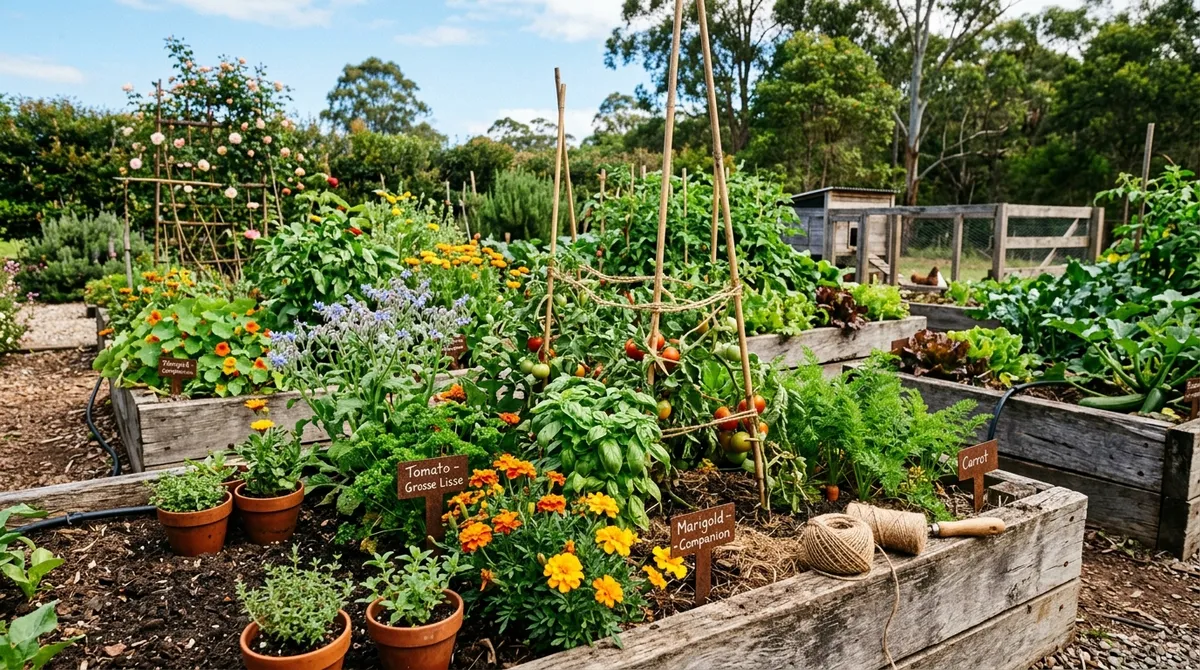
Companion planting in the Northern Rivers goes well beyond the classic "plant basil next to tomatoes" approach. The subtropical climate, long growing season, and diverse range of edible species make this one of the best regions in Australia for multi-layered food production. Food forests, guild planting, and living mulch systems produce more food per square metre than conventional rows, with less maintenance once established.
The Northern Rivers has a long history of this approach. Permaculture co-founder Bill Mollison developed many of his food forest concepts in the subtropics. Properties around Nimbin, The Channon, and the hinterland have been running productive multi-layered food systems for decades. The principles work on any scale, from a quarter-acre block in Lismore to a large rural property near Kyogle.
🌱 Plants in this guide: Banana, Peas, Lablab, Beans (bush), Peanuts and Avocado. Each plant profile has sowing times for your region, companion plants and common pests.
Food Forest Layers
A food forest mimics natural forest structure, arranging edible plants in layers from canopy to ground cover. The Northern Rivers climate supports all seven recognised layers.
- Canopy layer (8-15 metres): Avocado, macadamia, mango, jackfruit. These tall trees form the upper canopy, providing shade and wind protection for everything below. Space them 8-10 metres apart to allow enough light for lower layers.
- Sub-canopy layer (4-8 metres): Citrus, coffee, mulberry, pawpaw, tamarillo. These medium trees grow in the filtered light beneath the canopy. Citrus and coffee produce well in the dappled shade of macadamia or avocado.
- Shrub layer (1-4 metres): Pigeon pea, banana, guava, feijoa, blueberry (in acidic soil pockets). These bushy plants fill the space between tree trunks. Pigeon pea is especially valuable because it fixes nitrogen and can be cut back repeatedly for mulch material.
- Herbaceous layer (under 1 metre): Turmeric, ginger, galangal, comfrey, lemongrass. Perennial herbs that tolerate the shade created by upper layers. Turmeric and ginger are ideal understorey crops because they naturally grow in forest shade.
- Ground cover layer: Sweet potato, pinto peanut (Arachis pintoi), nasturtium, strawberry. These spreading plants cover bare soil, suppress weeds, and prevent erosion during heavy rain.
- Vine layer: Passionfruit, choko, climbing beans, dragon fruit. Vines use tree trunks, fences, and trellises to access light without taking up ground space.
- Root layer: Yacon, cassava, sweet potato (dual purpose), taro. Underground crops that use soil space not occupied by other layers.
Banana Circles
Banana circles are one of the most productive companion planting systems for the Northern Rivers. They recycle kitchen scraps and garden waste into a continuous supply of bananas and companion crops.
Dig a pit 1-2 metres in diameter and about 1 metre deep. Mound the excavated soil around the edges to create a raised ring. Plant 4-6 banana plants (Lady Finger, Ducasse, or Cavendish) into the raised mound, evenly spaced. Fill the central pit with kitchen scraps, garden prunings, and organic waste. Greywater from the kitchen can also be directed into the pit.
Plant companion species around the outside of the banana circle. Sweet potato covers the ground and produces tubers. Taro grows in the moist conditions near the base. Comfrey produces nutrient-rich leaves that can be chopped and dropped as mulch. Lemongrass planted on the outer edge provides a useful barrier and windbreak.
The central pit acts as a continuous compost system. Organic matter decomposes and feeds the banana roots directly. The bananas, in turn, provide shade for understorey companions and produce large quantities of organic matter (spent leaves and pseudostems) that cycle back into the pit. A well-managed banana circle produces 40-80 kilograms of bananas per year, plus tubers, herbs, and compost.
Nitrogen-Fixing Plants
Nitrogen is the nutrient most gardens need in the largest quantities, and the Northern Rivers' heavy rainfall leaches it from the soil quickly. Nitrogen-fixing plants capture atmospheric nitrogen through bacterial colonies in their root nodules, making it available to surrounding plants.
- Pigeon pea (Cajanus cajan): The single most useful nitrogen fixer for Northern Rivers gardens. Grows 2-3 metres in one season, produces edible peas, and generates large amounts of mulch material when cut back. Plant it between fruit trees as a "chop and drop" species. Cut it to 30 centimetres when it reaches full height; the nitrogen-rich foliage breaks down quickly as mulch, and the plant regrows.
- Lablab bean (Dolichos lablab): A vigorous climbing legume that fixes nitrogen and produces edible beans and flowers. Grows rapidly in warm weather and can cover a trellis in weeks. Good for shading out weeds on bare ground.
- Coral tree (Erythrina): A deciduous tree that drops nitrogen-rich leaves in winter. Provides light shade for understorey crops. Fast-growing and easily propagated from large cuttings pushed into moist soil.
- Wattle (Acacia): Many local Acacia species fix nitrogen. A. maidenii and A. melanoxylon (blackwood) are native to the Northern Rivers. Use them as windbreaks and pioneer species to improve degraded soil.
- Pinto peanut (Arachis pintoi): A perennial ground cover legume that fixes nitrogen while protecting soil from erosion. It tolerates light foot traffic, produces small yellow flowers, and grows well in the Northern Rivers' warm, moist conditions. Excellent as a living mulch under fruit trees.
Living Mulch Systems
Living mulch means growing ground-covering plants instead of (or in addition to) conventional mulch materials. In the Northern Rivers, the warm, wet conditions break down conventional mulch quickly, requiring frequent replacement. Living mulch is self-sustaining.
Sweet potato is the best living mulch for warm-season gardens. Plant cuttings 30 centimetres apart between rows of taller crops. The vines cover the ground within 4-6 weeks, blocking light and suppressing weeds. Bonus: you harvest edible tubers when you clear the bed.
Pinto peanut (Arachis pintoi) is the best permanent living mulch. Once established, it forms a dense mat of glossy green leaves that never needs mowing, fixes nitrogen, and tolerates moderate shade. It takes 6-12 months to fully establish but is then virtually maintenance-free. Available from subtropical nurseries and some landscaping suppliers in the Northern Rivers.
Comfrey (Bocking 14 variety, which does not spread by seed) is excellent around fruit trees. The deep roots mine minerals from the subsoil. Cut the leaves 4-5 times per season and lay them as mulch beneath trees. Comfrey leaves decompose quickly and release potassium, nitrogen, and phosphorus. Each plant produces 2-4 kilograms of leaf material per cut.
Practical Guild Combinations
A guild is a group of plants chosen to support a central productive species. Here are three proven guilds for Northern Rivers gardens.
Avocado Guild
Central tree: avocado. Understorey: coffee (shade-tolerant, produces in filtered light). Ground cover: sweet potato or pinto peanut. Nitrogen fixer: pigeon pea (chop and drop). Pest confuser: lemongrass (repels some insects). Nutrient accumulator: comfrey (deep roots, mineral-rich mulch).
Citrus Guild
Central tree: lemon or orange. Companions: nasturtium (attracts beneficial insects, suppresses weeds). Nitrogen fixer: lablab bean on a nearby trellis. Herb layer: lemongrass, society garlic (both deter some pests). Ground cover: pinto peanut. Mulch plant: comfrey.
Banana Circle Guild
Central feature: banana circle with compost pit. Inner ring: taro, turmeric, ginger (moisture-loving understorey crops). Outer ring: sweet potato (ground cover), lemongrass (windbreak), comfrey (nutrient accumulator). Vine: passionfruit trained up a dead banana pseudostem or trellis.
Frequently Asked Questions
What is companion planting in a subtropical food forest?
Companion planting in a subtropical food forest means arranging plants in layers that support each other. Tall canopy trees (avocado, macadamia) provide shade for mid-storey species (coffee, citrus). Understorey plants (turmeric, ginger) use the filtered light beneath the canopy. Ground covers (sweet potato, pinto peanut) protect the soil. Nitrogen-fixing trees and shrubs feed the system. Each layer fills a role, and the combination produces more food per square metre than any single crop grown alone.
What are the best nitrogen-fixing plants for the Northern Rivers?
Pigeon pea (Cajanus cajan) is the most useful nitrogen fixer for Northern Rivers gardens. It grows to 2-3 metres in a single season, fixes atmospheric nitrogen through root nodules, produces edible peas, and can be cut back to create mulch material. Other excellent nitrogen fixers include coral tree (Erythrina), wattle (Acacia), tropical kudzu (Pueraria), and lablab bean (Dolichos lablab). Rotate legume crops through vegetable beds to add nitrogen between heavy-feeding crops.
How do banana circles work?
A banana circle is a ring of banana plants surrounding a central compost pit. Dig a pit 1-2 metres wide and 1 metre deep, then mound the excavated soil around the edges. Plant 4-6 banana plants into the raised mound. Kitchen scraps, garden waste, and greywater go into the central pit. The bananas feed on the decomposing organic matter and the moisture from the pit. Sweet potato, taro, and comfrey planted around the base create a productive, self-sustaining system.
What living mulch works best in the Northern Rivers?
Sweet potato is the best living mulch for the Northern Rivers. It spreads rapidly in warm conditions, covers bare soil within weeks, suppresses weeds, and produces edible tubers. Pinto peanut (Arachis pintoi) is a perennial ground cover that fixes nitrogen and tolerates foot traffic. Comfrey (Bocking 14 variety) grows in part shade, produces nutrient-rich leaves for composting, and does not spread by seed. Nasturtium fills gaps quickly and attracts beneficial insects.
Plant profiles
Each profile has sowing times for your region, companion plants and common pests.
Free Monthly Planting Calendar
Get a personalised email each month with what to plant, seasonal tips, and harvest reminders for your region.
We send one email per month. Unsubscribe any time.