
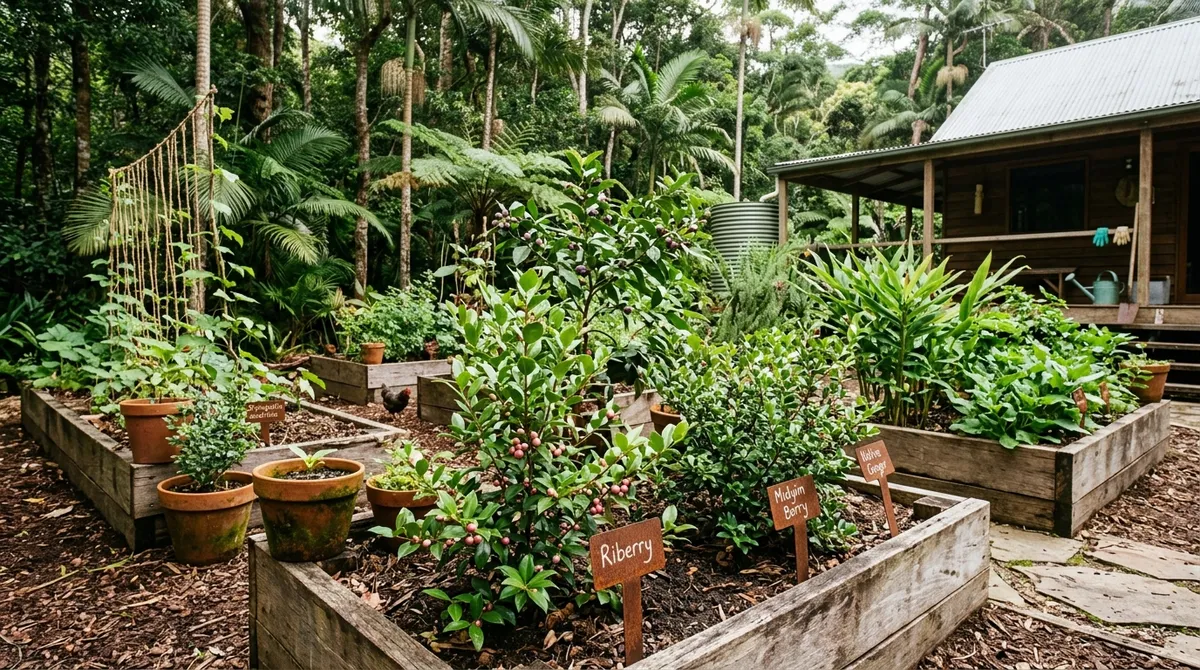
Growing Native Edibles in the Northern Rivers
Davidson plum, lemon myrtle, finger lime, and other rainforest foods from the Big Scrub region
The Northern Rivers sits at the heart of Australia's native food movement. The subtropical rainforests that once covered this region (the Big Scrub, Nightcap Range, and Border Ranges) are home to some of the country's most valued edible plants. Davidson plum, lemon myrtle, finger lime, and native ginger all evolved here. They grow naturally in the warm, wet conditions and rich volcanic soils that define the Northern Rivers landscape.
Growing native edibles in this region is easier than growing them anywhere else in Australia. These plants are already adapted to the local climate, soil, and rainfall. They need less water than exotic crops, tolerate heavy rain, resist most local pests, and provide food with distinctive flavours that chefs pay premium prices for.
🌱 Plants in this guide: Davidson Plum, Lemon Myrtle, Finger Lime, Native Ginger and Midyim Berry. Each plant profile has sowing times for your region, companion plants and common pests.
Top Native Edibles for the Northern Rivers
Davidson Plum (Davidsonia jerseyana)
Davidson plum is the signature native fruit of the Northern Rivers. The local species (Davidsonia jerseyana) is listed as endangered in the wild, making backyard cultivation both valuable and conservation-minded. The large, deep purple fruit has a sharp, tangy flavour and intense colour that makes outstanding jam, sauce, and ice cream. Commercial growers around Bangalow and Mullumbimby supply restaurants across Australia.
Plant in a partly shaded position with rich, well-drained soil. Davidson plum naturally grows in the understorey of rainforest, so it handles dappled shade well. It prefers protection from strong winds and full afternoon sun. Water regularly for the first two years, then reduce once established. Trees produce fruit directly on the trunk and main branches (cauliflory), with harvest from November to January. A mature tree yields 15-25 kilograms of fruit per season.
Lemon Myrtle (Backhousia citriodora)
Lemon myrtle contains more citral (the compound responsible for lemon flavour) than lemongrass, lemon verbena, or actual lemons. The leaves are used fresh or dried in teas, biscuits, cakes, dressings, and seafood dishes. The flavour is intensely lemony with floral undertones. Dried lemon myrtle leaf sells for $60-100 per kilogram.
Lemon myrtle grows naturally in the Nightcap Range and surrounding hinterland. Plant in full sun to part shade in well-drained soil. It grows as a tree to 8-10 metres but can be maintained as a hedge or large shrub with regular pruning. Harvest leaves year-round, though flavour is strongest in summer. The creamy-white flowers in summer are also edible and attract native bees. This species handles the Northern Rivers climate perfectly, requiring no supplementary watering once established.
Finger Lime (Citrus australasica)
Finger limes are native to the Northern Rivers rainforests and are one of Australia's most commercially successful bush food crops. The small, elongated fruit contains caviar-like vesicles that burst with citrus flavour. They are prized by chefs for garnishing seafood, cocktails, and desserts. Fruit sells for $40-80 per kilogram at local farmers markets in Bangalow, Byron Bay, and Lismore.
Plant grafted varieties for faster fruiting (2-3 years compared to 5-7 years for seedlings). Rainforest Pearl (pink vesicles), Crystal (clear), and Alstonville (green) are popular varieties available from Daleys Fruit Tree Nursery in Kyogle. Finger limes tolerate more shade than conventional citrus and suit the understorey layer of a food forest. They are thorny, so place them where the spines will not catch passers-by. Protect young trees from frost in hinterland areas above 200 metres.
Native Ginger (Alpinia caerulea)
Native ginger produces clusters of bright blue berries with a mild, gingery flavour. The berries are eaten fresh or used in jams and syrups. The plant grows to 2-3 metres and produces attractive white flowers followed by the blue fruit. It thrives in the Northern Rivers' warm, humid conditions and handles heavy shade, making it ideal for planting under taller trees.
Plant in rich, moist soil in a shaded or partly shaded position. Native ginger spreads by rhizomes and can form large clumps over time. It suits the understorey of a food forest or a shaded border along fences. Harvest berries from January to March when they turn bright blue. The plant is frost-tender, so hinterland gardeners should plant it in a protected position.
Midyim Berry (Austromyrtus dulcis)
Midyim berry is a low-growing ground cover (30-50 centimetres) that produces small, speckled white berries with a sweet, blueberry-like flavour. The berries are eaten fresh and make excellent jam. The plant is ornamental, with glossy green leaves and delicate white flowers.
Plant in full sun to part shade in well-drained soil. Midyim berry handles the Northern Rivers' heat and humidity well. It makes an excellent edible ground cover or border plant and grows well in containers. Harvest berries from December to February. Space plants 40-50 centimetres apart for a continuous ground cover.
The Big Scrub Connection
The Big Scrub was once the largest area of lowland subtropical rainforest in Australia, stretching from Byron Bay to Lismore and south to Alstonville. Less than 1 percent of the original forest remains, in scattered remnants around Booyong, Eureka, and along the Wilson River. Many of the Northern Rivers' native edible species evolved in this forest.
Growing these species in home gardens contributes to conservation. Davidson plum (Davidsonia jerseyana), in particular, is endangered in the wild, with fewer than 1,000 mature trees remaining in their natural habitat. Every garden-grown Davidson plum is a genetic insurance policy for the species. Big Scrub Landcare coordinates replanting efforts and occasionally makes plants available to home gardeners.
Designing a Native Food Garden
A food forest design suits native edibles perfectly. Layer plants by height: lemon myrtle or Davidson plum as the canopy (4-8 metres), finger lime and native tamarind in the mid-storey (2-4 metres), native ginger and native pepper in the understorey (1-3 metres), and midyim berry as ground cover. This layered approach mimics the natural rainforest structure and creates a productive, self-sustaining garden.
Combine native edibles with exotic subtropical fruit for a diverse food forest. Davidson plum grows well alongside avocado. Finger lime suits the edges of a banana circle. Lemon myrtle can act as a windbreak for more sensitive crops. The deep-rooted natives also stabilise soil on slopes and creek banks, a practical consideration in the Northern Rivers where erosion during heavy rain is common.
Sourcing and Planting
The Northern Rivers has several specialist native plant nurseries. Daleys Fruit Tree Nursery in Kyogle is Australia's largest supplier of grafted native fruit trees, including finger lime, Davidson plum, and Riberry. Barakee Native Nursery near Mullumbimby grows local-provenance native food plants. The Lismore Rainforest Botanic Gardens nursery stocks rainforest species suited to the region.
Plant native edibles in the warmer months (September to March) when root growth is active. Prepare planting holes with compost but avoid high-phosphorus fertilisers. Mulch with local leaf litter or arborist woodchip to 8-10 centimetres depth. Water new plantings through their first dry season (September to November and any dry spells). Most species are self-sufficient within two years.
Frequently Asked Questions
What native edible plants grow in the Northern Rivers?
The Northern Rivers is one of Australia's richest regions for native edibles. Davidson plum, lemon myrtle, finger lime, native ginger, midyim berry, and Riberry all grow naturally in the region's subtropical rainforests. Many of these species were part of the Big Scrub rainforest that originally covered the area from Byron Bay to Lismore. They are well-adapted to the local soil, rainfall, and climate.
Where can I buy native edible plants in the Northern Rivers?
Several local nurseries stock native edibles. Lismore Rainforest Botanic Gardens nursery is a specialist source. Barakee Native Nursery (near Mullumbimby) carries good selections. Big Scrub Landcare offers plants at community planting days. Online suppliers like Daleys Fruit Tree Nursery (based in Kyogle, within the Northern Rivers) ship native edibles across Australia.
Can I grow finger limes in the Northern Rivers?
Finger limes (Citrus australasica) are native to the Northern Rivers rainforests and grow exceptionally well in the region. They tolerate shade better than conventional citrus and suit the understorey of a food forest. Grafted varieties from Daleys Fruit Tree Nursery produce fruit in 2-3 years. Popular varieties include Rainforest Pearl (pink-fleshed) and Crystal (clear vesicles). Finger limes sell for $40-80 per kilogram at local farmers markets.
Do native edible plants need fertilising in the Northern Rivers?
Most native edibles are adapted to the region's soils and need minimal fertilising. Avoid high-phosphorus fertilisers, which can damage native plant roots (especially Proteaceae family members). Use a native-specific fertiliser or a light application of composted chicken manure in spring. The Northern Rivers' rich volcanic and alluvial soils already provide good nutrition for most species. Mulch with local leaf litter to maintain soil health.
Plant profiles
Each profile has sowing times for your region, companion plants and common pests.
Free Monthly Planting Calendar
Get a personalised email each month with what to plant, seasonal tips, and harvest reminders for your region.
We send one email per month. Unsubscribe any time.