
Best Fruit Trees for Small Sydney Gardens
Seven productive fruit trees and vines that fit in courtyards, small backyards, and even large pots
Sydney's shrinking block sizes mean most gardeners are working with limited space. A typical Inner West terrace has a courtyard of 20 to 40 square metres. A newer townhouse in the Hills District might have 50 square metres of usable garden. You need fruit trees that stay compact, produce fast, and actually suit Sydney's warm temperate climate.
These seven picks are proven in Sydney gardens. They fruit within 1 to 3 years, stay manageable with basic pruning, and taste dramatically better than anything from the supermarket.
🌱 Plants in this guide: Lemon Tree, Fig, Finger Lime, Passionfruit, Mulberry and Feijoa. Each plant profile has sowing times for your region, companion plants and common pests.
1. Dwarf Meyer Lemon
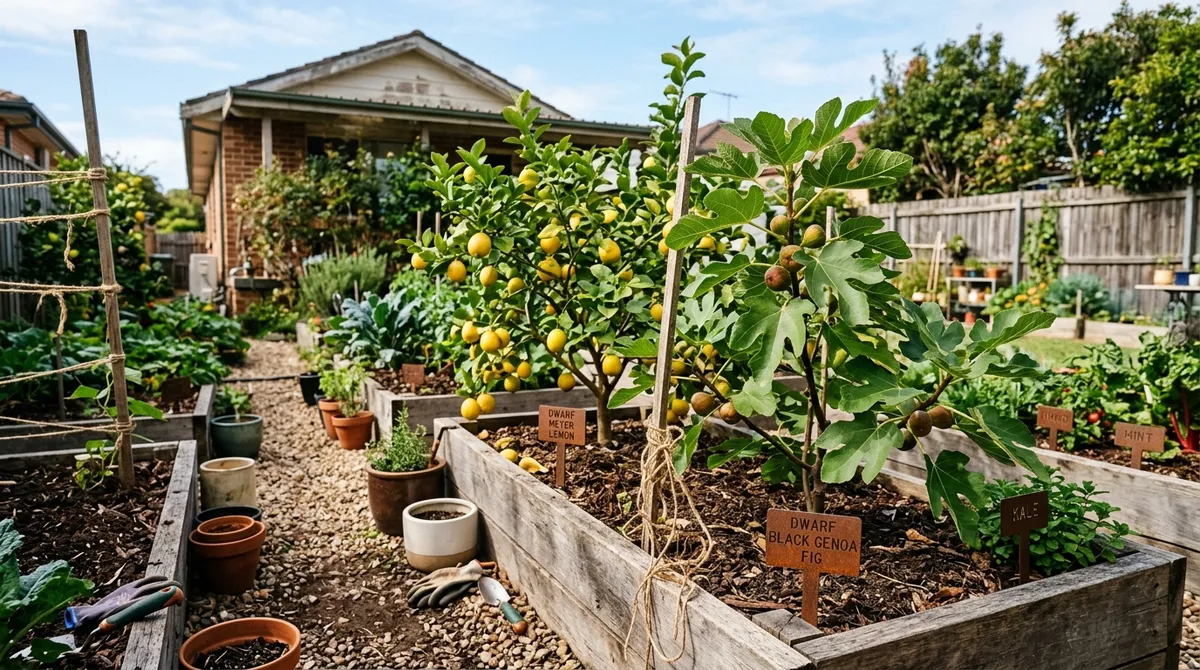
Every Sydney garden should have a lemon tree. The dwarf Meyer lemon stays under 2 metres in a pot or 2.5 metres in the ground. It fruits year-round in Sydney's climate, with the heaviest crop from May to September. Meyer lemons are sweeter and thinner-skinned than Eureka, with less pith and more juice.
Plant in full sun with well-drained soil. Feed with citrus fertiliser in August, November, and February. Water deeply twice a week in summer. A single dwarf Meyer lemon will produce 50 to 100 lemons per year once established.
Works well in a 50-litre pot on a sunny patio or courtyard.
2. Tahitian Lime
Limes are slightly more cold-sensitive than lemons, so coastal Sydney and the Inner West are better suited than Western Sydney. A Tahitian lime stays under 3 metres with pruning and produces fruit from January to June, peaking in autumn.
Limes need a warm, sheltered spot with full sun. A north-facing wall is ideal. They're more sensitive to frost than lemons, so if you're in Penrith or Camden, plant near a thermal mass (brick wall, concrete path) that radiates warmth at night.
3. Fig (Brown Turkey)
Figs love Sydney. They tolerate heat, handle drought once established, and produce abundantly from late January to March. Brown Turkey is the best variety for small gardens because it stays compact (2.5 to 3 metres), is self-fertile, and produces two crops per year in Sydney's climate: a small early crop in November (breba crop) and the main crop in February to March.
Figs are deciduous, so they lose their leaves in winter. This is useful in small gardens: the bare canopy lets winter sun reach plants underneath. Plant in full sun. Figs thrive in Sydney's clay soil once their roots establish. The only maintenance is light pruning in winter to keep the shape manageable.
Figs can also be espaliered against a fence or wall, taking up almost no ground space while producing 10 to 20 kilograms of fruit per year.
4. Finger Lime
An Australian native citrus that produces unique caviar-like fruit. Finger limes are naturally compact (2 to 3 metres), thorny, and extremely well adapted to Sydney's climate. They fruit from May to September, filling a gap when other citrus is finishing.
Finger limes tolerate part shade better than other citrus, making them suitable for gardens with 4 to 5 hours of direct sun. They grow well in pots (minimum 40 litres). The fruit is a gourmet ingredient that sells for $80 to $150 per kilogram at farmers markets, making this one of the highest-value plants you can grow in a small space.
5. Passionfruit (Nellie Kelly)
Passionfruit vines use vertical space, which makes them perfect for small gardens. Train them along a fence, pergola, or purpose-built trellis. A single vine can cover a 3 to 4 metre stretch of fence and produce 50 to 100 fruit per year.
Nellie Kelly is the standard variety for Sydney because it's grafted onto a disease-resistant rootstock. Plant in spring (September to November) in full sun with rich, well-drained soil. The vine will fruit from its second year, with the main crop from December to March.
Passionfruit vines are short-lived (5 to 7 years). Plan to replace them when production drops off. Remove and replace the soil around the planting hole when replanting to avoid rootstock diseases building up.
6. Dwarf Mulberry
The Dwarf Mulberry stays under 2 metres and produces masses of sweet, dark fruit from November to January. Mulberries are one of the easiest fruit trees for Sydney. They tolerate poor soil, irregular watering, and partial shade. The fruit stains everything it touches, so plant away from paths and clothes lines.
Mulberries fruit on new growth, so prune hard in winter (June to July) to encourage dense, productive branches. A dwarf mulberry in a 50-litre pot is a productive option for courtyards.
7. Feijoa (Pineapple Guava)
Feijoas are underused in Sydney. They're evergreen, drought-tolerant once established, and produce unusual fruit with a flavour somewhere between pineapple, guava, and mint. The trees stay compact (2 to 3 metres), handle light frost, and double as an attractive ornamental hedge.
Fruit ripens from April to June, falling from the tree when ready. Pick it up off the ground daily. Most feijoa varieties are self-fertile, but planting two different varieties (Apollo and Gemini, for example) improves fruit set and size. The flowers are also edible and taste like fairy floss.
Planting and Care Tips for Small Spaces
Espalier: Train citrus, figs, and feijoas flat against a wall or fence to save space. Espalier takes up as little as 30 centimetres of depth while covering 2 to 3 metres of wall.
Pots: Use minimum 40 to 50 litre pots for fruit trees. Terracotta or glazed ceramic is better than plastic, as it insulates roots from temperature extremes. Elevate pots on feet for drainage.
Feeding: Fruit trees in small gardens and pots need regular feeding because their root zone is limited. Apply slow-release fertiliser in spring and autumn, and supplement with liquid seaweed fortnightly during the growing season.
Watering: Deep water 2 to 3 times per week in summer rather than light daily watering. Mulch the root zone with compost or straw to retain moisture.
Frequently Asked Questions
What fruit trees grow best in small Sydney gardens?
The best fruit trees for small Sydney gardens are dwarf citrus (Meyer lemon, Tahitian lime), fig (especially Brown Turkey), finger lime, passionfruit vine, mulberry (dwarf varieties), and feijoa. All of these can be kept under 3 metres tall and produce fruit within 1 to 3 years of planting.
Can I grow fruit trees in pots in Sydney?
Dwarf citrus, finger lime, blueberries, and strawberry guava all grow well in large pots (minimum 40 to 50 litres) in Sydney. Use quality potting mix, feed regularly with citrus-specific fertiliser, and ensure adequate drainage. Potted fruit trees need more frequent watering than those in the ground, especially during summer.
When should I plant fruit trees in Sydney?
Plant fruit trees in Sydney from late autumn to early spring (May to September). Winter planting allows roots to establish before the demands of summer growth. Avoid planting in the heat of January and February. Container-grown trees from nurseries can be planted year-round but establish fastest in the cooler months.
Do I need two fruit trees for pollination in Sydney?
Most fruit trees recommended for small Sydney gardens are self-fertile, including citrus, fig, feijoa, and mulberry. You only need one tree. Passionfruit vines are also self-fertile. Some apple and pear varieties need a pollination partner, but these are less suited to small Sydney gardens due to their size and chill requirements.
Plant profiles
Each profile has sowing times for your region, companion plants and common pests.
Free Monthly Planting Calendar
Get a personalised email each month with what to plant, seasonal tips, and harvest reminders for your region.
We send one email per month. Unsubscribe any time.