🐔 Backyard Chickens in Australia
Which breed suits your climate, and do chooks actually pay for themselves?
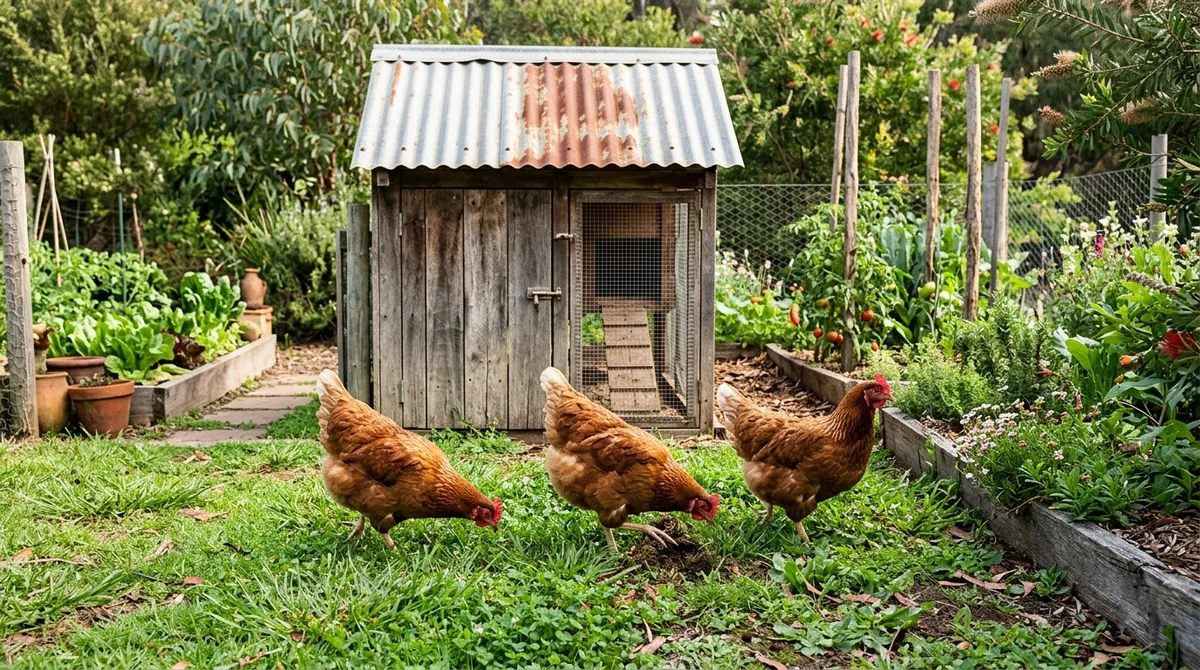
Egg prices have made backyard chooks the best-value pets in the country. Four hens lay roughly a dozen eggs a week for most of the year. At shop prices that's $300 to $700 a year, and they eat your kitchen scraps, make the best garden fertiliser, and clean up slugs and grasshoppers while they're at it. Use the two tools below to pick the right breed for your region and check the maths for your own setup.
 Do chickens pay for themselves?
 Which breed suits your backyard?
What backyard chickens cost
Getting started runs about $200 to $500. A flat-pack or secondhand coop is $150 to $400, point-of-lay pullets are $25 to $40 each, and a feeder, drinker and first bag of layer pellets add around $80. The running cost after that is small. Four hens get through a 20kg bag of feed every five or six weeks, so $30 to $40 a month covers feed, shell grit and fresh bedding. The calculator above runs the numbers on your own prices.
How many hens do you need?
Hens lay best in their first two years and slow down after that. Start with three or four for eggs on the table most weeks. A family of four who eat eggs regularly will want four to six. Chooks are flock birds and get stressed on their own, so never keep just one. Add a couple of young pullets every second spring and you will always have birds coming into lay. There is more in our guide to how many chickens you need and how many your council allows.
The best breeds to start with
An ISA Brown or Hy-Line is hard to beat for eggs and an easy life: friendly, cheap, and they out-lay everything. The Australorp is the classic Australian all-rounder, handling the cold, laying through winter, and holding a world laying record. Want pretty birds or coloured eggs? Look at the Araucana for blue, the Welsummer for dark speckled, or a Wyandotte for laced feathers. A Silkie or Pekin bantam wins with children every time. The picker above ranks all eighteen for your climate, and every breed has its own full profile.
Council rules, roosters and neighbours
Almost every Australian council lets you keep four to six hens on a suburban block with no permit. Roosters are the catch: most metro councils ban them, and you do not need one for eggs. Keep the coop about a metre off the boundary, stay on top of cleaning and drainage for smell, and the neighbours will be more interested in the spare eggs than the birds. Check your council site for the local numbers.
What keeping chickens is actually like
It is about ten minutes a day: let them out, top up food and water, collect the eggs, and shut the pop-hole at dusk so the foxes go hungry. Add a bigger clean once a month. They need shade and cool water through summer, and dark-feathered breeds feel the heat. Most breeds slow down or stop laying for a few weeks in the depths of winter, which is normal rather than a health problem. Give them your kitchen scraps and let them scratch through a finished garden bed, and they turn your waste into eggs and the best compost you will ever spread. New to all this? Start with our beginner's guide to getting chickens.
Track your flock in Planting Season Pro
Egg logging and graphs, feed costs, a breed guide tuned to your region, frost and heat alerts for the coop, plus the full garden planner. Manage your flock and your whole patch in one app, free to start, then Pro from $4.99 a month (or $129 once for life). The chicken-only apps charge US$80 a year, every year.
Start free →Go deeper
Not sure chickens are right?
Quick answers
Three to four hens. In peak season each lays 5 to 6 eggs a week, so four hens give you about two dozen weekly, enough for a family with some to give away.
Almost certainly yes. Most Australian councils allow 4 to 6 hens (no roosters) on residential blocks without a permit. Check your council's site for coop placement rules, usually a metre off boundaries.
Ten minutes a day: open, feed, water, collect eggs, lock up at dusk. A monthly coop clean. Less work than a dog, and the dog doesn't make breakfast.
More from the poultry guides
- Keeping the flock well The common backyard chicken health problems explained: mites and lice, worms, respiratory illness, sour and impacted crop, egg binding, bumblefoot and Marek's
- Keeping quail Raise coturnix (Japanese) quail in a small space: housing, ground space per bird, game-bird feed, eggs and meat, sexing and noise, biosecurity