Updated October 2026
How to Brew Kombucha Safely at Home
Kombucha is safe when it gets acidic quickly. Australia's Food Safety Information Council gives the checkpoints: black tea, 18 to 26°C, about 7 days, and a final pH below 3.0.
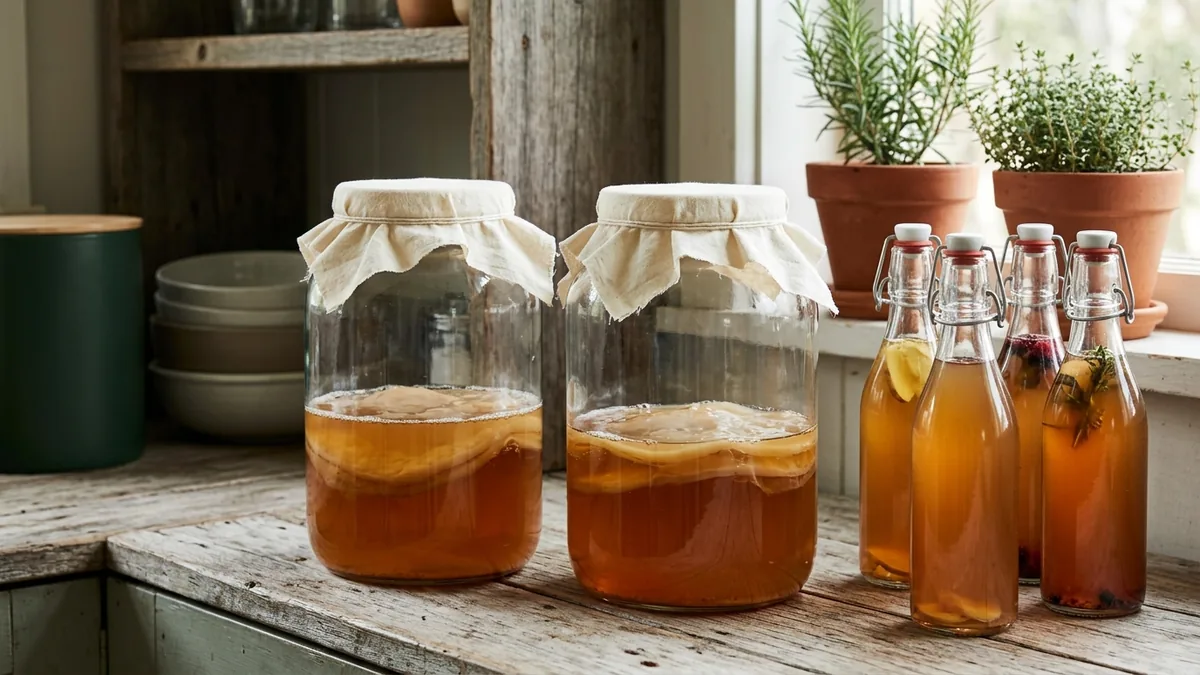
Brew black tea with sugar, cool it to 20 to 25°C within two hours, add a healthy SCOBY with its starter liquid, and ferment it in a glass or stainless steel vessel at 18 to 26°C for about 7 days. The Food Safety Information Council advises checking that the pH has fallen below 3.0 by then, and throwing the batch out if it has not reached that by day 10. Refrigerate the finished kombucha at 5°C or below, and drink no more than 125 ml a day.
Batch calculator
Enter your batch size in litres.
Kombucha Batch Calculator
Enter your finished batch size in litres and we will work out the tea, sugar and starter tea to begin.
Please enter a batch size greater than zero.
| Black tea | |
| White sugar | |
| Starter tea (mature kombucha) | |
| SCOBY |
Scaled from the NCHFP tested recipe (black tea version): per 3.8 litres, 6 black tea bags, about 200 g sugar, and a SCOBY with its starter liquid at pH 4.0 or lower.
Brewing, step by step
- Clean and sanitise. Wash everything, then hold it in water of at least 77°C for 30 seconds.
- Make the tea. Steep black tea for about 2 minutes in water at 71 to 77°C, take the tea out, and stir in the sugar.
- Cool it fast. Add cold water and get the brew down to 20 to 25°C within 2 hours. Split very large batches (5 litres or more) so they cool in time.
- Check the SCOBY. Throw out any culture with green, white, black or grey patches or an off smell. Test the starter liquid: it should be pH 4.0 or lower.
- Ferment at 18 to 26°C under a cloth for about 7 days, out of direct sun.
- Test the pH on day 7 with a meter or strips. Below 3.0, it is done. If not, test daily; at day 10 and still above 3.0, discard it.
- Remove the SCOBY and refrigerate the kombucha at 5°C or below.
The second ferment
Adding fruit and sealing the bottles builds fizz and alcohol. The Food Safety Information Council suggests limiting it to 7 to 10 days and ideally pasteurising: heat the kombucha to at least 83°C, fill clean glass bottles, seal at once and lay them on their sides for 3 minutes. Sealed bottles of live kombucha can build enough gas to burst, so use bottles made for carbonation and keep them in the fridge.
When to throw it out
Dry, fuzzy patches on the SCOBY or the surface, white or coloured, mean mould: discard the tea and the SCOBY. Brown strings, sediment and a new pale layer are normal.
Who should skip it
The Food Safety Information Council recommends no more than 125 ml a day for healthy adults, because kombucha is very acidic. People who are pregnant, immunocompromised, have kidney problems or a history of heavy drinking should be cautious, and people with diabetes should know it can affect blood sugar. Home brews can carry more alcohol than you expect, especially after a fruity second ferment.
Water kefir and milk kefir
We have not found a tested food safety method for water kefir, so we do not give a recipe. If you make it, the same habits apply: clean equipment, a plastic or nylon strainer, a short ferment and the fridge. For milk kefir, the Food Safety Information Council's rule is pasteurised milk only, because raw milk can carry bacteria that survive fermentation.
Sources we checked (October 2026): Food Safety Information Council, Kombucha and Fermenting food and drink at home; National Center for Home Food Preservation, Kombucha Tea; University of Georgia Extension, What's the Word on Homemade Kombucha? (2026); Phan and others, Lead poisoning from drinking kombucha tea brewed in a ceramic pot, Medical Journal of Australia, 1998.
Common questions
Is homemade kombucha safe?
It can be, if it acidifies properly. Use black tea, ferment at 18 to 26°C, and check the pH is below 3.0 by day 7 to 10. Discard any batch that does not get there or grows mould.
How much kombucha can I drink?
The Food Safety Information Council recommends no more than 125 ml a day for healthy adults.
Can I brew kombucha in a ceramic crock?
No. Acid can leach lead from glazes. Use glass or stainless steel.
Can I use green tea?
The Food Safety Information Council recommends black tea, because green and oolong tea produce more acid. The US tested recipe allows green tea, so the two sources differ; in Australia we would follow the local advice.