
Backyard Fruit Trees in Australia
Which fruit trees suit your region, when to plant them, and what to do when a tree will not fruit.
Updated October 2026
Fruit trees run on a different clock to vegetables. A tree planted this winter may not carry a proper crop for three to five years, so the choice of tree matters more than anything you do afterwards. Winter cold decides what will fruit where you live, the season decides when it goes in the ground, and fruit fly and possums decide how much of the crop you actually eat. Pick your region below and the page works through all of it, from the trees that suit each of the ten Planting Season regions to planting, pruning, pests, pots and the reasons a tree refuses to fruit.
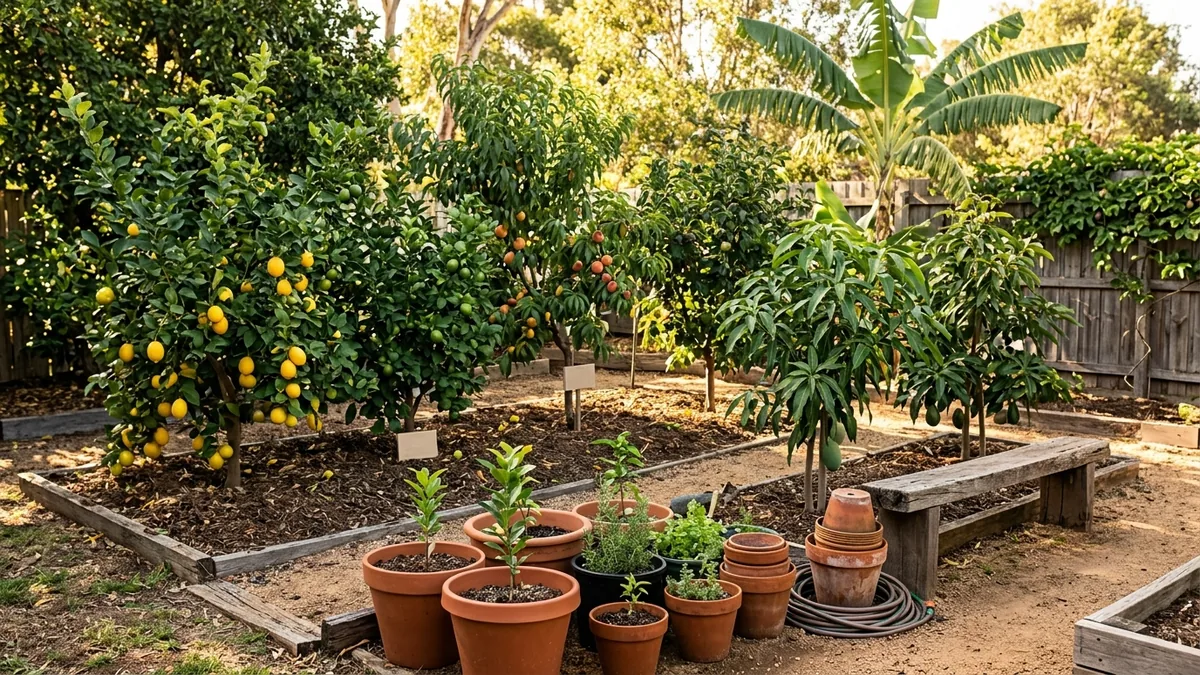
Start with your region
Choose your region and the three panels below show the winter chill your trees can expect, the fruit our regional calendar lists for it and the right pruning window for each type of tree.
Chill hours: will it fruit here?
Fruit that suits your region
When to prune, by fruit type
Citrus care
Feed citrus twice a year, in late winter and again in late summer, with a complete citrus food, and water deeply in dry spells. Prune lightly after harvest in late winter to early spring, just to shape and open up the centre, removing no more than about a fifth of the canopy. Watch for citrus gall wasp (cut out lumpy galls before spring), leaf miner (silvery squiggles on new leaves) and scale.
What fruit grows in each of the ten regions
Winter cold sorts Australian fruit into four groups, and the regional chill figures on this site (estimates for the whole region, so your own block can sit higher or lower) show which group you are in. Chill hours are the hours below about 7 degrees Celsius that a deciduous tree sleeps through each winter. Our Chill Hours helper and the low-chill fruit guide go further into how to match a variety to your winter.
- Cool climates (Canberra, Hobart, Melbourne): around 830 to 1,200 chill hours. Apples, pears, cherries, plums, apricots, walnuts, hazelnuts, chestnuts, quince, currants and blueberries all fruit well, and citrus is the stretch.
- Temperate climates (Sydney, Adelaide, Perth): around 300 to 640 hours. Plums, peaches, nectarines, figs, persimmons, olives and citrus are easy, apples and pears need the right variety, and the warmer fruit is a gamble in frost-free pockets.
- Subtropical climates (South East Queensland, Northern Rivers): about 300 hours at most, and often less on the coast. Choose low-chill peaches, nectarines, plums and apples, and enjoy avocados, macadamias, mangoes, lychees, bananas and citrus.
- Tropical climates (North Queensland, Darwin): effectively no winter chill. Mango, banana, pawpaw, passionfruit, lychee, longan, rambutan, jackfruit, star fruit and citrus replace anything that needs a cold winter.
The planting months quoted below come from Planting Season's regional planting data, the same data that drives each plant page and each What to Plant Now region page.
Canberra & ACT (high chill, about 1,200 hours)
Canberra has the most winter chill of the ten regions, so apples, pears, cherries, plums, apricots, peaches and nectarines all go in as bare-root trees from June to August. Almonds, walnuts, hazelnuts and chestnuts suit the same cold, and so do blueberries (in acid soil), kiwifruit, quince, persimmons, currants, figs and mulberries. Frost at blossom time is the risk rather than winter cold: early apricot blossom is often lost in cold pockets, so choose later flowering types. Citrus is the stretch. Cumquat is the hardiest and is planted in November after the last frost, a Meyer-type lemon is marginal, and grapefruit is very marginal even on the warmest north-facing wall. Limes, avocados and mangoes are not suited.
Canberra & ACT: what to plant now
Tasmania (high chill, about 1,000 hours)
Tasmania suits the classic cool-climate orchard. Apples, pears, plums, cherries, apricots, peaches and nectarines all go in as bare-root trees from June to August, together with blueberries, raspberries, blackcurrants, redcurrants, gooseberries, walnuts, hazelnuts and chestnuts. Choose late-flowering peaches and nectarines to dodge spring frost, and plan a winter spray against leaf curl. The hardiest citrus is a Meyer lemon, planted October to November after the last frost in a warm sheltered spot, followed by cumquat and feijoa from September to November. Pomegranate and lime are marginal, and avocado, mango, banana, passionfruit and grapefruit are not suited. Our fruit fly data lists Tasmania as free, so avoid bringing in fruit.
Melbourne & Victoria (high chill, about 830 hours)
Melbourne gets enough winter chill for nearly every deciduous fruit. Apples, pears, plums, peaches, nectarines, apricots, cherries, almonds, walnuts, hazelnuts, chestnuts, quince, persimmons, figs, mulberries, kiwifruit, blueberries, raspberries and currants all go in from June to August. Citrus waits for the frosts to finish: the data puts Melbourne frosts at roughly mid May to mid September, so lemons, mandarins, oranges, blood oranges and cumquats go in from September to November, limes and finger limes in October and November, and passionfruit from October to December. Feijoa and loquat do well. Avocado and macadamia are marginal and need a warm, sheltered, north-facing spot with frost cloth while young. Mangoes, bananas, pawpaw and lychees are not suited. Victoria's household netting rule applies to anything you net.
Melbourne & Victoria: what to plant now
Adelaide & SA (low to medium chill, about 400 hours)
Adelaide has a Mediterranean climate with about 400 chill hours, a low-to-medium figure that suits a wide range. Apples, pears, plums, peaches, nectarines, apricots, almonds, walnuts, hazelnuts, chestnuts, figs, mulberries, persimmons and quince go in as bare-root trees from June to August. Cherries do best in the Adelaide Hills and the cooler south east, and on the plains you should choose a low-chill variety and expect light crops. Citrus goes in March to April or September to October, avocado, macadamia and guava in September to October (plant avocados on a raised mound in a warm sheltered spot), and passionfruit from September to November. Mangoes, bananas, pawpaw and lychees are not suited. Our fruit fly data treats Adelaide as a pest-free area.
Adelaide & SA: what to plant now
Perth & WA (low chill, about 300 hours)
Perth has about 300 chill hours on the coastal plain, so choose low-chill apples, plums, peaches and nectarines and plant them bare-root from June to August. The Hills and south west are colder and suit pears, apples and cherries; on the plain only low-chill cherries set fruit and crops are light. Lemons and limes go in from May to September. Avocados and macadamias go in from March to May and again from August to October, with the sand mulched heavily. Mangoes are possible in warm, sheltered gardens, planted October to December, and an early or mid-season type such as Kensington Pride suits better than a late one. Guava (September to November) and passionfruit (September to November) do well. Dragon fruit and bananas only suit Perth's warmest coastal microclimates, and lychees and pawpaw are not suited. Medfly is the fruit fly to plan around.
Sydney & Coastal NSW (medium chill, about 640 hours)
Sydney's regional chill figure of about 640 hours hides a wide spread, with coastal suburbs well below the west and the mountains. Citrus (March to September), avocado and macadamia (March to September), figs, mulberries, persimmons and loquats do well across the region. For apples and pears, plant bare-root trees from June to August and choose to suit your suburb: on the coast, low-chill apples (Anna, Dorsett Golden, Tropic Sweet) and low-chill pears or nashi, while western Sydney has enough chill for Granny Smith, Gala and Pink Lady. Peaches, nectarines and plums also go in from June to August. Apricots are marginal on the humid coast, where spring rain brings brown rot, and sweet cherries are not reliable at all (Bilpin and Orange are the nearest cherry districts). Passionfruit goes in from September to March. Mango, banana, pawpaw, lychee and dragon fruit are marginal and only worth trying in warm microclimates.
Sydney & Coastal NSW: what to plant now
Northern Rivers NSW (low chill, about 300 hours)
The Northern Rivers has around 300 chill hours and grows subtropical fruit very well. Citrus goes in from March to September, along with avocado and macadamia, and mangoes, bananas, pawpaw, lychees, longans, guavas, custard apples, dragon fruit, pineapples and jackfruit all suit the warmth, with most planted from September onwards. Passionfruit goes in from September to April. Deciduous fruit needs the right variety: apples should be low-chill (Anna, Dorsett Golden and Tropic Sweet planted together, because Pink Lady and Fuji will not crop), pears should be Hood, Flordahome or a nashi, and peaches, nectarines and plums go in as bare-root trees from June to August. Apricots are marginal (a low-chill selection such as Glengarry in the cooler hinterland), and sweet cherries are not reliable.
Northern Rivers NSW: what to plant now
South East Queensland (low chill, about 300 hours)
South East Queensland has about 300 chill hours at most, and often less on the coast. Citrus goes in from March to September, avocado and macadamia in the same months, and the warm fruit (mango, banana, pawpaw, lychee, longan, custard apple, dragon fruit, pineapple, passionfruit and guava) from September onwards. Deciduous fruit needs low-chill varieties planted as bare-root trees from June to August: Tropic Snow and Flordaprince peaches, an Arctic Star nectarine, Satsuma or Mariposa plums, low-chill apples and the Sunshine Blue blueberry. Figs, mulberries, persimmons and jujubes do not mind the mild winter. Nashi and raspberries are marginal on the coast and far better on the Granite Belt, and apricots and sweet cherries are not reliable. Fruit fly is established from late August.
South East Queensland: what to plant now
North Queensland (nil chill, about 50 hours)
North Queensland has effectively no winter chill (about 50 hours), so apples, pears, stone fruit, cherries, grapes, olives and blueberries are not suited. The tropical orchard takes over: mango, banana, pawpaw, passionfruit, lychee, longan, rambutan, jackfruit, star fruit, dragon fruit, soursop, sapodilla, black sapote and white sapote, with most planted from September into the wet season. Lemons and limes are planted in the dry season, from May to October, and the data says they thrive and fruit year-round. Avocado and macadamia go in from May to September, and figs and mulberries from May to July. Fruit fly is a year-round problem here, peaking in the wet.
North Queensland: what to plant now
Darwin & Top End (nil chill, about 0 hours)
Darwin gets no winter chill at all, so the deciduous fruit list is empty, but the tropical list is long. Mango, banana, pawpaw, passionfruit, lychee, longan, rambutan, jackfruit, star fruit, dragon fruit, soursop and sapodilla suit the Top End, with most planted from September into the wet season. Lemons and limes are planted in the dry season, from May to October, avocado and macadamia from May to September, and figs and mulberries from May to July. Custard apple and tamarillo are not suited. Fruit fly is present all year and peaks in the wet.
Darwin & Top End: what to plant now
When to plant fruit trees
There are two planting seasons. Deciduous trees (apples, pears, plums, peaches, nectarines, apricots, cherries, figs, persimmons and the nut trees) go in as bare-root trees in winter, from June to August in every region where our data lists them. Nurseries sell them without soil for these few months, they cost less than potted trees and come in far more varieties, and they establish quickly because they are planted while dormant. Citrus and the tropical and subtropical fruit go in as potted trees at a different time in each region, because frost, summer heat and the wet season all push the window around.
The table below is generated from the planting data for each region. Lemon stands in for citrus, and other citrus can sit a month either side, so check the plant page for the fruit you want. Where our data calls a fruit marginal in a region, the cell says so.
| Region | Apple (bare-root) | Peach (bare-root) | Lemon (citrus) | Mango | Passionfruit | Avocado |
|---|---|---|---|---|---|---|
| Canberra & ACT | June to August | June to August | Marginal: November | Not suited | Marginal: November | Not suited |
| Tasmania | June to August | June to August | October to November | Not suited | Not suited | Not suited |
| Melbourne & Victoria | June to August | June to August | September to November | Not suited | October to December | Marginal: October to November |
| Adelaide & SA | June to August | June to August | March to April, September to October | Not suited | September to November | September to October |
| Perth & WA | June to August | June to August | May to September | October to December | September to November | March to May, August to October |
| Sydney & Coastal NSW | June to August | June to August | March to September | Marginal: October to January | September to March | March to September |
| Northern Rivers NSW | June to August | June to August | March to September | September to March | September to April | March to September |
| South East Queensland | June to August | June to August | March to September | September to March | September to April | March to September |
| North Queensland | Not suited | Not suited | May to October | September to March | September to April | May to September |
| Darwin & Top End | Not suited | Not suited | May to October | September to March | September to April | May to September |
Months are planting months from the Planting Season regional planting data. Bare-root stock is only sold in winter, so if you miss June to August, buy a potted deciduous tree and plant it in autumn or winter rather than in summer heat.
Choosing a tree
Start with chill, then check the rootstock
Match the variety to your winter before anything else. A high-chill apple in a warm garden grows into a healthy-looking tree that flowers weakly and drops its fruit, and no amount of feeding fixes it. Reputable fruit tree nurseries print the chill hours on the label, and if it is not stated, ask before you buy. Our plant data lists the low-chill choices for warm gardens, such as the Tropic Snow and Flordaprince peaches, the Arctic Star nectarine, the Satsuma and Mariposa plums, the Anna and Dorsett Golden apples and the Sunshine Blue blueberry, and the mid-chill choices for cooler ones, such as the Pink Lady apple at 400 to 500 hours, the Moorpark apricot and the Hosui and Kosui nashi at roughly 550 to 600 hours.
Most fruit trees are two plants grafted together: a named variety on top of a rootstock that sets the size and soil tolerance of the tree. A dwarfing rootstock keeps a tree at one to two metres instead of five, which makes it easier to net, prune and pick from the ground. Ask the nursery what the rootstock is. Watch for shoots that grow from below the graft join, which look different (often thornier on citrus) and take over if left; cut them off at the trunk.
Pollination partners and self-fertile varieties
Some trees fruit on their own and some need a second variety flowering at the same time. From our plant data:
- Need a partner: apples and pears (a different variety of the same fruit), most plums, most cherries, kiwifruit (a male and a female plant), feijoa and nashi (a second compatible nashi, or a European pear such as Williams). Avocados set better with an A-type and a B-type tree.
- Self-fertile or mostly so: peaches, nectarines and apricots (bees still lift the crop), the Satsuma plum, the Stella, Lapin and Sunburst cherries, the Sunshine Blue blueberry, figs and citrus.
- A matched pair works in warm gardens: Anna and Dorsett Golden apples pollinate each other, and the data recommends planting Anna, Dorsett Golden and Tropic Sweet together in the Northern Rivers.
Short of space? A multi-grafted tree carries several varieties on one trunk and solves pollination in a single pot. Bee-friendly planting keeps pollinators visiting through flowering.
Buy from a local nursery and choose a grafted tree
A nursery that serves your climate stocks varieties proven to fruit there, and staff can tell you the chill hours and the local fruit fly rules. Choose grafted, named trees over seedlings: you know what fruit you will get, and the tree fruits years sooner. Most trees take three to five years to bear. Figs and passionfruit are quicker, often one to two years, while seedlings of avocado and mango can take far longer than a grafted tree.
Planting and first-year care
- Pick the spot. Full sun (at least six hours), free-draining soil and room for the mature tree. Keep cold-sensitive fruit such as citrus, avocado and mango away from frost hollows, and put them against a north-facing wall in Canberra, Hobart and Melbourne.
- Soak bare-root trees. Stand the roots in water for one to two hours, then trim damaged roots. On a bare-root tree, shorten whippy top growth to balance the roots.
- Dig a wide, shallow hole. About twice as wide as the root ball and no deeper than the pot, so the graft join sits clearly above the soil. On heavy clay, plant on a low mound 20 to 30 centimetres high rather than in a deep hole filled with bought soil, which turns into a sump. Avocados die when their roots sit wet, so a mound matters most for them.
- Backfill with the soil you dug out. Firm it gently, water in well and add a thick layer of mulch, kept a hand's width off the trunk.
- Water deeply, not daily. A long soak once or twice a week while the tree establishes builds deeper roots than a daily sprinkle. In the first summer, check the root zone before each watering.
- Protect the trunk and the tree. A trunk guard or white paint shields thin bark from sunburn and brushcutters. Use frost cloth over young citrus and avocados on cold nights in the south.
- Net or bag early. Plan the netting frame when you plant, not the week the fruit colours. A tree kept low enough to net from the ground is far easier to protect.
Expect little fruit in year one. The first year is for roots, so water, mulch and leave the pruning to a light shaping. The propagation guide covers raising your own trees from cuttings and grafts once you are hooked.
Pruning, feeding and watering
Pruning by fruit type
Our pruning guide sets the timing, and the table in the region panel above applies it to your region. In short: apples, pears, quinces, figs, grapes, mulberries and persimmons are pruned while dormant in winter, June to August. Apricots, cherries, almonds and plums are pruned in late summer to early autumn, after harvest, on a warm dry day, because cuts made in cool wet weather let in bacterial canker and silver leaf. Peaches and nectarines also do better pruned after picking. Citrus gets only a light shape in late winter to early spring once frost risk has passed. Mangoes and avocados are pruned after harvest.
Whatever the tree, aim for an open vase shape with light reaching the centre, and keep it low. Keeping trees small makes netting, picking and fruit fly control possible.
Feeding
Feed apples with a balanced fertiliser in late dormancy and mulch well. Feed citrus twice a year, in late winter and late summer, with a complete citrus food, and avoid feeding heavily while the tree is in flower. Sources disagree on the exact schedule (some feed every two to three months through the warm season, others skip winter altogether), so in cool southern gardens feed less and in warm northern gardens feed little and often through the growing season. A tree that is all leaf and no fruit is usually over-fed with nitrogen, so back off. Our fertilising guide and mulching guide cover the details.
Watering
Deep, infrequent watering beats a little every day. Water more while fruit is swelling and through flowering, and less once the crop is picked. Trees in pots dry out much faster than trees in the ground, and black nursery pots heat up in summer. See the watering guide for the numbers.
Fruit fly, pests and diseases
Fruit fly comes first
Fruit fly is the defining problem for Australian backyard fruit, and Queensland fruit fly stings more than 100 kinds of fruit, including stone fruit, citrus, apples, pears, loquats, guavas, tomatoes and passionfruit. The timing is everything: act before the fruit ripens, because by the time you see maggots it is too late. The Fruit Fly Tracker gives your region a month-by-month plan, and the fruit fly pest page shows how to identify it. The fruit fly picture differs by region:
| Region | Fruit fly status | Active months |
|---|---|---|
| Canberra & ACT | Established | October to April |
| Tasmania | Fruit fly free | Not applicable |
| Melbourne & Victoria | Established | October to May |
| Adelaide & SA | Pest-free area (outbreak zones can be declared) | Not applicable while pest free |
| Perth & WA | Mediterranean fruit fly (Medfly) | October to May |
| Sydney & Coastal NSW | Established | October to May |
| Northern Rivers NSW | Established | August to May |
| South East Queensland | Established | August to May |
| North Queensland | Established | All year (peaks in the wet) |
| Darwin & Top End | Established | All year (peaks in the wet) |
Status and active months come from the fruit fly data behind the Fruit Fly Tracker.
What works, in order of reliability:
- Exclusion. Cover the tree with fine mesh on a frame held clear of the fruit, or bag individual fruit and clusters. Fit it after pollination, as soon as fruitlets can be handled, and keep it on only while the fruit ripens. Western Australia's Department of Primary Industries and Regional Development suggests mosquito netting, shade cloth or flyscreen over a poly pipe frame.
- Hygiene. Pick up fallen fruit, pick fruit at colour break, and never compost or green-bin stung fruit. Seal it in a bag and freeze it, or leave it double bagged in the sun for one to two weeks, then put it in the rubbish. Keeping trees small makes this doable.
- A both-sex protein bait or trap sold for home gardens, used to its label. Lure traps for males only tell you fruit fly is around, they do not protect fruit. Use bait on top of netting and hygiene, never instead of them.
Western Australia's Medfly is a declared pest with mandatory control in some shires, including Armadale, Kalamunda, Mundaring, Serpentine-Jarrahdale and Swan, plus Carnarvon. Tasmania is fruit fly free, so keep fruit from the mainland out and report suspect larvae to Biosecurity Tasmania. Rules change, so check your state agriculture department before you move fruit or buy plants. DPIRD Western Australia: Mediterranean fruit fly.
Possums, birds and flying foxes
Net before the fruit colours. In Victoria, household fruit netting must have a mesh of 5 mm by 5 mm or less at full stretch, which means a finger cannot fit through it, and the rule covers both selling and using it (Whitehorse City Council sets it out; Agriculture Victoria administers it). White, taut netting pegged at the base is the safest everywhere because loose, large-mesh netting traps wildlife. If an animal is tangled, do not handle it yourself; call your state wildlife rescue. See possums, birds and flying foxes.
The pests and diseases that turn up most
Start with the mildest fix: hand removal, exclusion and tidy-up first, then a registered product used exactly to its label if you need one. A few examples from our pest pages:
- Peach leaf curl can only be prevented. Spray a registered copper or lime sulphur product at early bud swell, before any green tip shows, wetting the whole tree. Once the leaves have curled, spraying does nothing, so pick off the worst and feed the tree.
- Brown rot is controlled by removing every mummified fruit, cutting out blighted blossoms and opening the canopy. Check that any fungicide's label lists stone fruit and brown rot and respect the withholding period.
- Citrus gall wasp: we could not find a product registered for home gardens, so cut out galls and bag them before the adults emerge in spring (from late August in Queensland to mid October through mid December in the south). Never put galls in green waste.
- Scale and citrus leaf miner: a registered horticultural oil sprayed on thoroughly in mild weather, under 30 degrees, to the label.
- Codling moth: bag fruit early, pick up fallen fruit twice a week and use cardboard trunk bands to trap larvae.
- Bronze orange bug: pick off nymphs while small, in spring, wearing gloves and eye protection because they spray a caustic fluid.
Always read the label, check the crop is listed and keep to the withholding period before you pick. Registered neem (Eco-Neem) is labelled for ornamentals only, so it is not a fruit tree product. We do not publish homemade spray recipes for fruit trees. The only kitchen mix we suggest is milk at one part to nine parts water, for powdery mildew on leaves.
Small spaces and pots
A balcony or courtyard can still grow fruit. Dwarf trees, patio varieties and trees grafted onto a dwarfing rootstock stay small enough for a large pot and still make full-size fruit. Use a pot at least as wide as the minimum below, a free-draining premium potting mix and drainage holes in the base, keep the tree in full sun and water when the top few centimetres dry.
| Fruit | Minimum pot (from our plant data) | Notes |
|---|---|---|
| Lemon, lime, mandarin, orange, blood orange | 50 cm or wider, dwarf varieties | The classic pot fruit; dwarf rootstocks and a move-indoors option for cold areas. |
| Cumquat | 40 cm or wider | Listed as ideal in pots. |
| Blueberry | 40 cm or wider, acidic mix | Needs acidic potting mix and rainwater where you can. |
| Pomegranate | 40 cm or wider | Hardy and forgiving of neglect. |
| Feijoa | 50 cm or wider | Plant two for reliable fruit set. |
| Apple, pear, peach, nectarine, plum, apricot, cherry | 50 cm or wider, dwarf varieties | Partial fit: dwarf and columnar forms only. Choose by chill hours. |
| Passionfruit, grape, kiwifruit | 50 to 60 cm or wider, with a strong trellis | Climbers need the support more than the pot. |
| Olive, guava, mango, avocado | 50 to 60 cm or wider, dwarf varieties only for mango and avocado | Partial fit; slow and best in warm gardens. |
| Strawberry | 20 cm or wider, or a hanging basket | The easiest fruit to start with. |
Fruit that does not suit pots in our data includes pawpaw, banana, lychee, rambutan, jackfruit, quince, pomelo, the nut trees and the large tropical sapotes. Read dwarf fruit trees for small spaces, citrus in pots, growing food in small spaces and vertical gardening before you buy. Potted trees need a feed and water more often than trees in the ground, and repotting every third year or so keeps them going.
Why isn't my fruit tree fruiting?
Choose what you see and the finder points to the most likely cause and the fix. The common causes sit below it for reading in order.
Fruiting finder
Why won't my tree fruit?
The most common reasons, roughly in order:
- Too young. Many fruit trees take 3 to 5 years to bear. Patience first.
- Wrong chill for your region. A high-chill variety in a warm zone may never fruit. See the chill panel above.
- No pollination partner. Many apples, pears, plums and cherries need a second compatible variety nearby.
- Too much nitrogen. Lots of leafy growth and no fruit usually means over-feeding with high-nitrogen fertiliser.
- Bad weather at flowering. Cold, wet or very windy weather during bloom stops bees working and drops fruit set.
- Biennial bearing. Some trees (especially apples and citrus) crop heavily one year then rest the next. Thin fruit in the heavy year to even it out.
- Over-pruning. Cutting off the fruiting wood, or pruning at the wrong time, removes next season's crop.
- Fruit fly. Stung fruit drops early. See the Fruit Fly Tracker.
- Not enough sun or water. Fruit trees need at least six hours of sun, and a dry spell at flowering or fruit swelling makes a tree drop what it set.
- Sucker growth from the rootstock. If the vigorous shoots are below the graft join, cut them off; they never bear useful fruit and they take the tree's energy.
The longer version, with fixes, is in why your fruit tree isn't fruiting. For tomatoes and capsicums that flower without setting, see tomato flowers, no fruit and capsicum not setting fruit.
Every fruit and nut guide
Each fruit has a full how-to-grow guide with a regional planting calendar, and a plant page with varieties, spacing and companions. Pick your fruit below.
Citrus
- Lemons (plant page)
- Lime (plant page)
- Oranges (plant page)
- Blood orange (plant page)
- Mandarin (plant page)
- Grapefruit (plant page)
- Pomelo (plant page)
- Tangelo (plant page)
- Cumquat (plant page)
- Finger lime (plant page)
Apples, pears and old-fashioned tree fruit
- Apple (plant page)
- Pear (plant page)
- Nashi (plant page)
- Quince (plant page)
- Medlar (plant page)
- Persimmon (plant page)
- Feijoa (plant page)
- Loquat (plant page)
- Pomegranate (plant page)
- Jujube (plant page)
Stone fruit
- Peach (plant page)
- Donut peaches
- Nectarine (plant page)
- Plum (plant page)
- Apricot (plant page)
- Cherry (plant page)
- Almond (plant page)
Nuts
- Walnut (plant page)
- Hazelnut (plant page)
- Chestnut (plant page)
- Pecan (plant page)
- Macadamia (plant page)
- Bunya nut (plant page)
Subtropical and tropical fruit
- Avocado (plant page)
- Mangoes (plant page)
- Banana (plant page)
- Pawpaw (plant page)
- Passionfruit (plant page)
- Lychee (plant page)
- Longan (plant page)
- Rambutan (plant page)
- Jackfruit (plant page)
- Pineapple (plant page)
- Guava (plant page)
- Custard apple (plant page)
- Soursop (plant page)
- Sapodilla (plant page)
- Black sapote (plant page)
- White sapote (plant page)
- Star fruit (plant page)
- Dragon fruit (plant page)
- Jaboticaba (plant page)
- Tamarillo (plant page)
Figs, vines and other easy fruit
- Figs (plant page)
- Mulberry (plant page)
- Grapes (plant page)
- Kiwifruit (plant page)
- Olives (plant page)
- Carob (plant page)
- Pepino (plant page)
- Cape gooseberry (plant page)
- Elderflower (plant page)
- Honeydew melon (plant page)
Berries and currants
- Strawberries (plant page)
- Blueberries (plant page)
- Raspberries (plant page)
- Blackberry (plant page)
- Boysenberry (plant page)
- Blackcurrant (plant page)
- Redcurrant (plant page)
- Gooseberry (plant page)
Australian native fruit
- Davidson plum (plant page)
- Kakadu plum (plant page)
- Riberry (plant page)
- Midyim berry (plant page)
- Native raspberry (plant page)
- Quandong (plant page)
- Bush tomato (plant page)
Guides across all fruit
Tools and region pages
What to plant this month, by email
One short email at the start of each month with the crops to plant in your region, and the ones to skip. Free, no spam, unsubscribe any time.
Questions about backyard fruit trees
Which fruit trees grow best in Australia?
It depends on winter cold. Cool regions such as Canberra, Hobart and Melbourne suit apples, pears, cherries, plums and apricots. Mild regions such as Adelaide, Perth and Sydney suit plums, peaches, figs, persimmons and citrus, with low-chill apples. Subtropical Queensland and the Northern Rivers suit citrus, avocado, macadamia and mango, and North Queensland and Darwin suit mango, banana, pawpaw, passionfruit and lychee. Use the region picker above to see the list for your region.
When is the best time to plant a fruit tree in Australia?
Plant bare-root deciduous trees such as apples, pears, plums, peaches and cherries from June to August, while they are dormant. Plant citrus and tropical fruit as potted trees at the time that suits your region. For lemons that means Melbourne from September to November, Tasmania from October to November, Canberra in November, Adelaide from March to April or September to October, Perth from May to September, South East Queensland, the Northern Rivers and Sydney from March to September, and North Queensland and Darwin from May to October.
How many chill hours do I need for fruit trees?
It depends on the fruit. Citrus, figs, mulberries and most tropical fruit need none, low-chill peaches, nectarines and apples need roughly 150 to 300 hours, mid-chill apples and nashi need around 400 to 600, and cherries need the most. Our regional estimates run from about 0 hours in Darwin to about 1,200 in Canberra, and your own block can sit higher or lower, so check the chill figure on the label before you buy.
Do I need two fruit trees to get fruit?
For apples, pears, most plums and most cherries, yes: plant a second compatible variety that flowers at the same time. Peaches, nectarines, most apricots, figs and citrus are self-fertile or mostly so. Kiwifruit needs a male and a female plant, and avocados set better with an A-type and a B-type. Anna and Dorsett Golden apples pollinate each other in warm gardens.
How long does a fruit tree take to fruit?
Most grafted fruit trees take three to five years to carry a real crop, though figs and passionfruit are often quicker and grafted citrus can give a small crop in its second or third year. Seedlings take much longer than grafted trees, which is why we recommend named, grafted trees from a local nursery.
How do I protect fruit from fruit fly without homemade sprays?
Cover the tree with fine mesh held clear of the fruit on a frame, or bag the fruit, as soon as fruitlets can be handled. Pick up fallen fruit, pick at colour break, and dispose of stung fruit by freezing it or sealing it in a bag in the sun, never in the compost. Add a both-sex protein bait or trap sold for home gardens, used to its label, on top of those steps and not instead of them.
What is the best fruit tree for a pot?
Citrus on dwarf rootstock is the classic choice, and a cumquat is listed as ideal for pots. Blueberries, pomegranates, feijoas and dwarf apples, peaches and nectarines also work in a pot at least 40 to 50 centimetres wide with good drainage. Water and feed pot trees more often than trees in the ground.
When should I prune fruit trees in Australia?
Prune apples, pears, quinces, figs and grapes while dormant in winter. Prune apricots, cherries, almonds and plums in late summer to early autumn after harvest, on a warm dry day, because winter cuts let in bacterial canker and silver leaf. Prune citrus only lightly, in late winter to early spring once frost risk has passed.
Chill figures are regional estimates to guide variety choice. Your own block can sit higher or lower depending on its microclimate. Planting months come from the Planting Season regional planting data. Fruit fly rules, registered products and netting laws change, so check your state agriculture department and the product label before you act.
Sources we checked: Planting Season regional planting data and plant pages; our pest, pruning and fruit fly guides; DPIRD Western Australia, Mediterranean fruit fly; Whitehorse City Council, Fruit tree netting (Victorian 5 mm netting rule); and our October 2026 review of what Australian gardeners ask, drawing on ABC Gardening Australia fact sheets, Sustainable Gardening Australia, NSW DPI Primefact 1188 and Daleys Fruit.